Motorists, Can We Call a Truce?

from RW Daily by Mark Remy

Peace-Sign-Sticker-(5150)Readers, if there’s one thing I dislike as a creator and consumer of media, it’s unoriginality.

And if there’s one thing I dislike as a runner, it’s hostile motorists.

So you can imagine my dismay when I saw the reader comments on a recent news story out of Augusta, Georgia, about two runners who were hit by a car early Monday morning.

The story itself is horrible, and still a bit sketchy: Two women, both age 39, were running (against traffic, I learned elsewhere) at 6:30 a.m. when  a vehicle hit one, sending her to the I.C.U., and grazed the other. (Click here and here to read more, but not much more.)

The reader comments, it may not surprise you to learn, are where things get unoriginal. And hostile. In a hurry.

I don’t know what possesses them, but a certain percentage of readers see a story like this one and invariably seize it as an opportunity to lambaste runners and/or cyclists. Sometimes they couch their comment in concern for the victim first, before laying in. I call this the “tragic but” model. For instance:

This is tragic and I sincerely hope that Ms. Johnson recovers fully. But why do runners and bicyclers think that they own the road …?

That’s from the first comment left on this article, by the way.

Other times, they dispense with the sympathy altogether, and get right to the bashing. Comment number two begins:

This is why there are County built parks , paths and tracks for the public to access …

Aaaaand… it goes on from there. And on. And on.

I’ve seen this movie before, and it always plays out the same way, give or take: hostile comment; hostile comment backing up previous comment; push-back from a runner/cyclist; hostile/belittling comment directed against runner/cyclist; centrist appeal for sympathy and cool heads; hostile comment; etc.

After a while, it’s just exhausting.

So I’m here to propose an end to this nonsense. I’m here to call for a truce.

In fact, I’ve put it in writing.

Admittedly, I’m not the ideal person to draft such a document. After all, I’ve been cycling and/or running on public streets and roads for about 25 years now. Naturally, I have some biases.

But, dammit, I don’t see anyone else stepping up. So I’ll take a crack. Here’s my first draft.

Motorists & Runners: a Pact for Peaceful Coexistence
WHEREAS the public roads are public, and whereas there is room for everyone — drivers, runners, cyclists, etc. — and whereas rage and hostility are counterproductive and only serve to endanger and agitate everyone, drivers included, and whereas absurdities and hyperbole are never conducive to progress, we, the undersigned do hereby embrace and agree to the following.

AS A RUNNER, I AGREE TO:
1. Obey all laws, just as I expect motorists to do.
2. Conduct myself with courtesy, and treat motorists with respect, knowing that they are human beings just as I am.
3. Run with the understanding that, even if I am “right” or have the law on my side in a certain situation, motor vehicles are large, fast, and extremely heavy, and can kill or maim me if I’m not careful. (Or even if I am.)
4. Engage, whenever possible, with motorists in a cordial manner — e.g., offering a small wave and smile whenever a driver makes an extra effort to give me wide berth while passing.
5. Respond to anger or taunts with Zen-like calm, rather than with anger of my own.
6. Remember that when I am running in public, I am — like it or not — a representative of all runners, and to behave accordingly.

AS A MOTORIST, I AGREE TO:
1. Obey all laws, just as I expect runners to do.
2. Conduct myself with courtesy, and treat runners with respect, knowing that they are human beings just as I am.
3. Drive with the understanding that, even if I am “right” or have the law on my side in a certain situation, motor vehicles are large, fast, and extremely heavy, and can kill or maim others if I’m not careful. (Or even if I am.)
4. Engage, whenever possible, with runners in a cordial manner — e.g., making an extra effort to give them a wide berth while passing.
5. Pay attention to my surroundings while behind the wheel, and not to a cell phone conversation or a text message.
6. Acknowledge that there are millions of runners in the U.S. — in cities, suburbs, and rural areas of all 50 states — and that it is therefore unrealistic to expect all of them to run “on the sidewalk” or on a “trail”; that runners pay taxes, too; that very few, if any, of them actually run “in the middle of the road“; and that there’s no reason we can’t all share the road peacefully.

Sound good? Did I miss anything? If so, speak up in the Comments, below, and let me know.

If you think I got it right — or mostly right — do me a favor and “sign” the truce, below. And forward to some friends, with instructions to do the same.

Silly? Yeah, probably. But it can’t hurt.

Meantime, to those runners struck in Georgia, especially the one in the I.C.U.: Best wishes for a full and speedy recovery.
Continue reading “Motorists, Can We Call a Truce?”

If having fun while engaged in legitimate transportation is wrong, check this out

Super Slide Opens in Singapore Airport

Singapore Airport

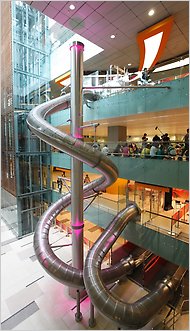
Who cares about delayed flights when you can pass the time riding a 40-foot-tall, jumbo twister slide?

Singapore’s Changi Airport recently unveiled the Slide@T3, the tallest slide in Singapore and, for the record, in any airport around the world. The attraction is the latest addition to a long list I like to call, “ridiculously amazing things to have in an airport,” including a movie theater, a rooftop swimming pool, and the Butterfly Garden (which is also home to a collection of 200 carnivorous or insectivorous plants).

For every $22 spent in the airport, adrenaline junkies (or really brave little kids) get tokens for two rides on the slide. Visitors who don’t want to travel at the speed of 19 feet a second, can take a ride down the shorter, one-and-a-half-story tall slide located at Terminal 3 Basement 2, which is free.


Continue reading “If having fun while engaged in legitimate transportation is wrong, check this out”

One year car free!

from BikeSkirt by Elisa

First, apologies (again) for my absence in posting.  Things are so busy with work and Bici that when I get home I have nothing left in me to write.  I do miss you all, and am hopeful that things slow down soon.

Last week, I celebrated 2 big days…my 31st Birthday and my one year anniversary of being car free!  It was any other day…riding around to meetings and friends houses.  Nothing special about the day, in fact it practically came and went before I remembered.

What has being car free taught me?

That my friends rock.  When it rains, when I need a ride home from the Greyhound station, when I need to borrow a car to head to a conference 2 hours away…they always show up.  It is amazing.

That Birmingham’s public transport really does suck.  In one year I have yet to take it.  The reason?  I can’t figure the damn thing out!  The maps are all separate and trying to get from one end of town to the next takes hours and multiple bus transfers (on a less than timely bus “schedule”).  For those people who don’t even have bikes, I am not sure how they do it.

That the hottest summer in history makes for a lot of sweaty meetings.  Seriously, I spent most of the summer wiping sweat from my brow while talking to people about food security!

That I can eat as much food and drink as much beer as I want and not worry.  Sure, I have gained some weight, but I still look the same (muscle weight, baby!) and feel great.

That your gas costs go down, but your food intake goes WAY up.  I eat so much food.

That I am not sure I ever want a car!!

Thanks everyone for all of your support.  This year has been great and terrible and I never regret selling my car.  Freedom!!!

Continue reading “One year car free!”

What is ‘smart growth,’ anyway?

by

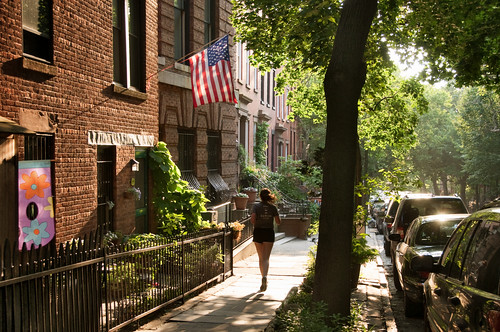
  Joralemon St, Brooklyn Heights (by: Steve Minor, creative commons license)

Lots of us have tried to answer that question in various ways, perhaps most frequently via the Smart Growth Network’s well-known ten principlesEmpire State Future has recently posted some answers of their own that I really like:

“It’s the effort to build a healthy economy that offers real choices in transportation, housing, and education while respecting farmlands, open space, and our many natural and historic resources. By building more homes and businesses in already-existing communities, we can save valuable open space and conserve money spent on our roads and costly utility infrastructure. All of which makes Smart Growth important for our future, and for our children’s future . . . 

“Why shouldn’t it be simpler for us to work toward a more attractive and economical civic future? A future where

  • new development is constructed in places that maximize existing public investment in schools, roads, water and sewer service, transit facilities and information infrastructure.
  • workers have good jobs that are within walking distance or an easy commute by bike, bus, rail or automobile
  • farm land is protected from encroachment so it can continue to be used to raise livestock and crops, providing a continuing and strong agricultural sector, and rivers, lakes, streams and ponds are pollution-free and provide recreational opportunities for residents and tourists alike
  • people can choose to live in older, thriving communities that are beautiful and unique, and that validate the reality that this is still the Empire State!”

Read the full post and find links to lots more about the work of Empire State Future here.

Move your cursor over the images for credit information.

Kaid Benfield writes (almost) daily about community, development, and the environment.  For more posts, see his blog’s home page. 

Continue reading “What is ‘smart growth,’ anyway?”

Abogo transportation costs made transparent

What is Abogo?

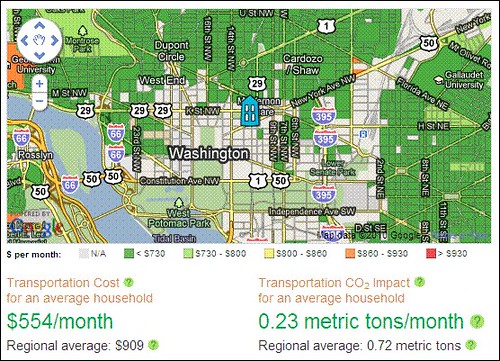
Abogo shows you how transportation impacts the affordability and sustainability of where you live. With Abogo, you can discover the costs of where you live now, or where you might want to live. Abogo measures the money an average household from your region living in your neighborhood would spend getting around, including car ownership, car use, and transit use.  It also tells you what the CO2 generated by this car use would be.  With this information, you can measure the true cost and impact of where you live.

Housing + Transportation Affordability Index
H + T logo

Abogo is powered by the Center for Neighborhood Technology’s Housing + Transportation Affordability Index. Instead of only counting just your housing costs, the idea behind H + T℠ is to include the cost of getting around when thinking about the cost of living in a certain place.  This gives you a more complete idea  of how the neighborhood fits for your budget.

But wait, there’s more to come!

We’ll be adding features to our site, including:

  • personalized transportation costs
  • housing costs
  • saved searches
  • …whatever else you might think of! Send ideas to abogo-info@cnt.org.

image
Continue reading “Abogo transportation costs made transparent”

How to handle an encounter when you’re unjustly pulled over

By Bob Mionske
Most people don’t follow traffic laws. Motorists speed. Cyclists roll stops. Pedestrians jaywalk. And that is where the police come in–to enforce the laws. It’s good that they do, because when people on the road obey the law, we are able to predict with some measure of accuracy what will happen, allowing us to avoid most collisions. But what about when the officer is just plain wrong on the law? There are three things to keep in mind during any such encounter.
If you’re ordered to stop, then stop. The officer is not going to let you ignore an order, and the situation will become worse if you attempt to do so, even if you’re in the right.
Let the officer be in charge. Police officers are trained to maintain control of encounters. If you attempt to take control, you will find the tension escalating very quickly. So keep your interactions polite. Besides, nobody likes dealing with unpleasant people.
Be absolutely certain you are right. This means that you must not only know your state’s laws, but also any relevant local laws. Unless you’re sure, do not assume that the officer is wrong.
Beyond these rules, how you handle the encounter will depend on your goal. If you simply want to continue on your way with minimal hassle, then you should politely comply with the officer’s interpretation of the law. If you want to assert your rights under the law, then ultimately you must be willing to be ticketed, go to court and fight the citation.
However, when you were first stopped, the officer may not yet have decided to ticket you; he may have merely intended to have a talk with you. In this case you have an opportunity to discuss why you believe you were in the right. If you want to try to convince the officer that you were riding lawfully, keep in mind that your greatest chance for success is in not demeaning the officer. For example, it might be useful to have a copy of your local traffic laws on hand as a reference source, but suggesting that the officer should read the laws probably isn’t such a good idea.
Often an officer will relent, particularly when he knows that you’re right but stopped you for your own good, because he thinks that where you were riding is unsafe. But if the officer continues to insist that you are violating the law, your only recourse will be to ask the officer to cite you, which means your fate ultimately will be decided by a potentially disinterested traffic court judge burdened by a heavy docket. Still, that’s the place to use all your evidence and powers of persuasion–far better than having an interaction with an officer go south and decide your fate for you.
[B’ Spokes: I disagree with the above paragraph. We have had a lot of success writing to the Chief of Police after the fact, no citation needed.]

Continue reading “How to handle an encounter when you’re unjustly pulled over”

If you ride near pedestrians, you may be doing the rest of us a disservice.

By Bob Mionske
I was returning from a ride, but one of my main routes home was closed for bridge repairs, so I had to use another bridge to cross the river (with eleven bridges connecting the city across the Willamette River, there’s a good reason Portland is nicknamed “Bridgetown”). The alternate route I chose was a bridge with a multi-use path that is wide enough for about three or four pedestrians standing side by side. It was noon, and there were people walking, jogging, and pushing strollers. And of course, cyclists were present.
I was passed by a cyclist, and fell in behind him. As we approached someone walking in the same direction in which we were traveling, I slowed to pass, but the cyclist in front of me just kept his speed. When he was about 10 feet behind the pedestrian, he moved over to the left just enough to avoid hitting the pedestrian from behind. Then he careened back to the right just in time to avoid riding head-on into a jogger. I waited until it was safe to pass, and then proceeded with caution past the pedestrian at about 8 mph. Coming from the opposite direction, I saw another biker doing better than 15 mph. He overtook a pedestrian by swerving over into our half of the walkway, causing me to brake hard to avoid a collision. This behavior was repeated by other cyclists for the duration of my ride across the bridge, and it got me thinking about how we cyclists treat other traffic.
When we’re on the road, we are the underdogs, and I applaud cyclists who stand up for themselves when their rights are being violated. But if some of us are standing up for our rights while simultaneously violating the rights of others around us, that’s hypocritical, and makes for terrible public relations with the majority of the public that doesn’t ride. Further, demanding courtesy and respect from a non-cycling public while not respecting those people will only make it that much harder for us to achieve gains for cyclists.
Beyond this pragmatic perspective—that bad PR is bad for cycling, this isn’t just about PR. At it’s core, this is about common courtesy and respect for the rights of other people.
Ironically, I think that some of the behavior we are seeing is generated by “sunshine cyclists.” These are the people who only ride in the fair weather of the summer months; most of the year, they are in their cars. Now, I think it’s great that people are riding, even if it’s only for a few months out of the year, and even if it’s only because everybody else is doing it. And I think there may be a lot of different reasons why some cyclists seem to ride so discourteously. Some may just be utterly clueless about riding, beyond the basics of keeping the bike upright; some may believe the hype that that’s how cyclists ride; and some may just be self-centered people who ride the same way they drive—with utter disregard for anybody but themselves.
Regardless of which type of cyclist the fair-weather rider is, they are all less invested in relationships between cyclists and others, and therefore, in the affects of their behavior. Fair-weather riders especially seem to have no regard for pedestrians or motorists as they blithely weave around motorists, pedestrians, and other cyclists—and the brunt of any ill-will created by these riders will be borne by year-round cyclists. A pedestrian on a multi-use path doesn’t see somebody who just got on a bike for the first time in 10 years, and is just plain clueless about how to ride around others; all the pedestrian sees is a “cyclist.” And the same thing is true of the “cyclist” who drives most of the year, and thinks that riding without regard for the rules or for common courtesy is part of “the freedom” of being a cyclist. And what about the bully who pushes people around regardless of whether he’s driving or riding? All the pedestrian sees is a “cyclist.”
Of course, not every discourteous cyclist is a fair-weather cyclist. Some year-round cyclists really do believe that their “freedom” means they have rights without corresponding responsibilities to others. And some percentage of people are just inconsiderate, regardless of their chosen mode of getting around; you’ll find them driving, you’ll find them walking, and yes, you’ll find them riding a bike. In my experience, there are fairly few cyclists who are this callous, but again, the impression they create about “all cyclists” is lasting. And of course, because they don’t care about anybody but themselves, they also don’t care that they are creating lasting negative impressions that affect the rest of us.
This means that it’s up to the rest of us—the vast majority of cyclists—to set a better example. One place to begin is on the multi-use path. For cyclists who are used to riding on the road in traffic, the multi-use path can perhaps present a difficult mental transition. On the road, we are at the bottom of the “food chain.” However, once we are on a multi-use path (or “MUP”), we are suddenly the “top predator.”
And even though time spent on the MUP may only represent a brief portion of our ride, the impression about cyclists we are leaving is much greater, relative to our time spent on the MUP, because we interact so closely with pedestrians when we are on the MUP. And of course, these pedestrians are also in all likelihood motorists (and probably voters, too), which means that impressions we create on the MUP will continue to reverberate long after we’ve left the MUP.
It makes sense then, for us to make an effort to create a better environment for everyone (and in the process, improve our P.R.). We can do simple things, like taking care not to frighten or endanger pedestrians when we’re passing them. Besides not creating a lasting bad impression, riding courteously around pedestrians will mean that we are lessening the risk of collisions. And it also means that we are exercising the due care that the law requires of us. It’s a win-win, and it doesn’t cost us a thing.

Continue reading “If you ride near pedestrians, you may be doing the rest of us a disservice.”