
The solution to congestion is more travel lanes for cars
But at some point that thinking does not work.
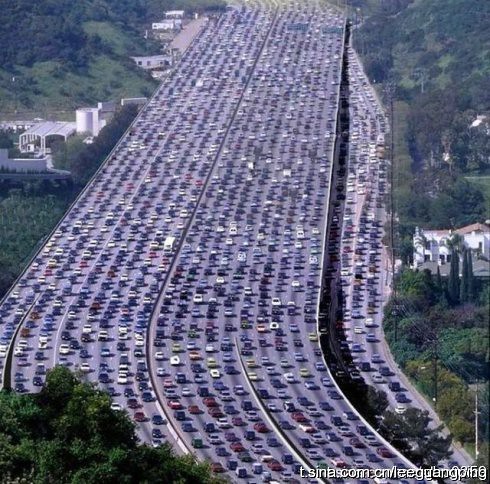
copyright: Lee from t.sina.com.cn
Continue reading “The solution to congestion is more travel lanes for cars”
Road Rage: A Culturally Acquired Habit
[B’ Spokes: Most cycling advocates look toward better roads, better laws, better enforcement, and better public education campaigns to improve conditions for cyclists but what if the real key was to get people not to get so upset when then have to use the brakes slightly… in other words learn how not to feed road rage. What impressed me about "Congressional Testimony on Aggressive Driving" Dr. Leon James is how drivers get upset by having to adjust their speed… it’s not just cyclists they are upset with, it’s the whole world. This behavior needs to be addressed and retrained! Anyway an excerpt from the paper:]
***************************************
Dr. Leon James
Professor of Psychology
University of Hawaii
1997
Road Rage: A Culturally Acquired Habit
Driving and habitual road rage have become virtually inseparable. Why? What causes aggressive driving and habitual road rage? And everybody points to the same factors: more cars—>more traffic—>more frustration—>more stress—>more anger—>more hostility—>more violence. More cars leads to more aggression on the roads, sort of like rats fighting in a crowded colony.
Given this logic the standard solutions are: more and better roads, better cars, better laws, better enforcement, and better public education campaigns. Even individual and group therapy. All of these approaches have been helpful, but in my opinion, they are not sufficient to contain and eliminate the epidemic of road rage.
The culture of road rage has deep roots. We inherit aggressive and dangerous driving patterns as children, watching our parents and other adults behind the wheel, and by watching and absorbing bad driving behaviors depicted in movies and television commercials.
I was astounded the first time I listened to drivers who had tape recorded their thoughts and feelings in traffic, speaking their thoughts aloud while driving, giving a sort of play-by-play of what it’s like inside the private world of the driver. This was the first time in the history of psychology that self-witnessing data became available through hundreds of drivers speaking and recording their thoughts in traffic. One feature that particularly amazed me was the pervasive negativity of their thoughts and feelings. In a kind of Jekyll and Hyde effect perfectly ordinary, friendly, good-hearted people tend to become extremely intolerant and anti-social as soon as they get behind the wheel. Behind the wheel their personality undergoes a rapid transformation, from polite and tolerant to inconsiderate, intolerant and emotionally unintelligent.
As a result of my studies, I’ve concluded that aggressive drivers need other behavioral modification techniques to manage their competitive impulses on the road. I refer to this set of emotional management techniques as "inner power tools" for smart driving.
It took several years of research for me to understand the psychological mechanism of emotionally impaired driving. The car is not only an object of convenience, beauty, and status. It is also a cultural and psychological object, associated with the driver’s internal mental and emotional dynamics, our ego. Cars are an extension of the self, they are ego-laden objects that can be used both positively and negatively to get our own way on the road. The automobile offers us a means to exercise direct control over our environment. When we enter the car we use it as an outlet for regaining a sense of control. Automobiles are powerful, and obedient. They respond instantly and gratifyingly to our command, giving us a sense of well being that comes with achieving control over one’s environment.
The pace of life has increased for the majority of the population. Many have commented on the general feeling of loss of control in their lives. And yet it is human and natural to seek a sense of control in our lives, we want to feel we’re getting somewhere, that we’re not wasting time, that we’re doing the right and just thing, that we’re free to pursue our own interest- unfettered.
What happens when someone thwarts our sense of freedom? For example, while driving along in a pack of vehicles, a car in the left lane suddenly darts into your lane just ahead of you. Your foot automatically lifts from the gas pedal and taps the brakes, just enough to maintain distance. At this point, aggressive drivers feel thwarted because they were forced to alter what they were doing. That driver forced you to lift your foot two inches. "What a moron. What an idiot." You feel an explosion of fury inside. It gets very hot. You might even begin to perspire. You grip the wheel harder. Now you’ve arrived at the decisive moment: you can let the emotion die out, or you can fan the flames with thoughts of indignation and retaliation. Aggressive drivers do not let the momentary emotional flare die down.
I discovered that many drivers I’ve worked with haven’t learned the emotional skills they need to handle such routine emergency situations. The violation of their sense of personal freedom instantly arouses negative emotions that escalate in sequence from frustration to hostility to hatred. The fact is that aggressive driving is a cultural norm because our culture condones the expression of hostility whenever we feel wronged.
Continue reading “Road Rage: A Culturally Acquired Habit”
Elon woman charged in hit-and-run
Accompanying Photos

Photo Caption:
Robin Stanfield Ragsdale
ELON — An Elon woman on probation after she was convicted of killing four people in a wreck in 2007 was arrested today and charged in a hit-and-run that injured an Elon University student on Wednesday.
Robin Stanfield Ragsdale, 35, of 500 James Toney Drive is charged with felony hit and run, according to a news release from police.
A tip led police Ragsdale’s home. After an interview, she confessed to striking the victim and said she fled the scene because she panicked, according to the release.
Toorialey Fazly is a 26-year-old exchange student at Elon. He was riding a bike east on West Lebanon Avenue near the Elon campus when he was hit near North Lee Avenue.
Witnesses said the car that hit Fazly was a white sedan driven by a woman.
Fazly was taken by helicopter to Duke University Hospital in Durham where he is in stable condition.
Ragsdale was convicted in 2008 of four misdemeanor counts of death by vehicle. She received suspended sentences of 45 days in jail on each count and five years probation, officials said.
According to police reports, Stanfield was driving west on University Drive in an Isuzu sport utility vehicle when it ran off the road and struck four people on July 14, 2007. The four were trying to load a broken-down Mercury Cougar onto a trailer.
Michael Todd King, 43, of Swepsonville, and Mildred Jones Isley, 57, Freddie Charles Coulter, 55, and Sandra Goins Coulter, 51, all of Graham, were killed.
BIKE BOOKS: Around The World On A Bicycle
from Jim Langley’s Bicycle Beat
I heard a while ago that Google was scanning books and making them available online, but I never expected to be able to read Around The World On A Bicycle by Thomas Stevens on a computer. Stevens was the first cyclist to bike around the world, leaving the west coast in 1884 and returning to America 13,000 miles and two years later.
He did the entire trip on a highwheel bicycle, also known as an ordinary or penny farthing. It was quite an accomplishment when you consider that approximately 1,000 people died from falls off these bicycles in the 10 years they ruled the roads. It’s cool also to think that highwheels were the first tall bicycles and among the first fixies too, so Stevens was way ahead of his time.
Stevens financed his adventure by filing reports from the road that were published by Harper’s and Outing magazines. Perhaps this explains how his story became a 2-volume, roughly 1,000-page epic. The actual books are highly collectible and can fetch as much as $500 per volume. You can also find them in some libraries, though they typically won’t let you bring them home to read.
It’s nice that we can all now read it and enjoy the great illustrations whenever and however we want. To get you started I’ve embedded Volume 1 – From San Francisco to Teheran. Here’s the link to the book on Google in case the embed doesn’t offer full functionality. Incidentally, the furthest I’ve ridden in a day on my 1886 Victor Light Roadster highwheel is 100 miles in Scotland in 1990.
Continue reading “BIKE BOOKS: Around The World On A Bicycle”
Your Health: Air pollution affects brain, heart, blood vessels
By Kim Painter, USA TODAY
If you pay attention to air quality reports, you may have noticed this: Even on the extra-hot days frying much of the country this summer, "code red" and "code orange" warnings — indicating high levels of ozone pollution — are becoming less common in many cities. Other measures of air quality also have improved greatly, experts say, 40 years after passage of the federal Clean Air Act.
That’s the good news. Here’s the bad: Scientists now believe air pollution is harder on health than once suspected, and that it’s not just lungs that suffer. Hearts, blood vessels and brains do, too.
"We’ve also learned that what we used to think of as fairly low or moderate levels of exposure still has a health impact," says C. Arden Pope, a researcher at Brigham Young University in Provo, Utah.
Bottom line: Better air has saved lives, but air pollution remains a major health problem. That’s one reason the Environmental Protection Agency recently proposed new curbs on power-plant emissions in Eastern states.
Pope was among authors of a new statement on air pollution issued in May by the American Heart Association. It said evidence linking air pollution to heart disease and deaths has "substantially strengthened" since the group’s last review in 2004. The group found:
•Strong links with heart attacks.
•Growing evidence for links to heart failure, stroke, irregular heart beats, cardiac arrest and vascular diseases.
•A "small yet consistent" link between short-term exposure to high pollution levels and death.
"The evidence is quite compelling," Pope says.
While risks to individuals are small and are dwarfed by risk factors such as smoking, high blood pressure and obesity, the overall effect on the public is big, says Robert Brook, a cardiologist at the University of Michigan and lead author of the report.
Much of the worrisome data concerns "fine particulate matter" — tiny bits of soot that come from burning coal, oil, diesel fuel or wood, mostly in factories, vehicles and power plants.
"These fine particles get deep into the lungs," says Norman Edelman, chief medical officer of the American Lung Association. Scientists are not sure what happens next. But the leading theory is that inflammation in the lungs spreads to blood vessels, damages them and makes them more likely to narrow and clog.
It’s also possible that some fine particles seep into blood vessels and the blood itself, causing direct damage. Dirty air also may trigger irregular nervous system activity that affects the heart and blood vessels.
"It’s probably not just one mechanism," Pope says. In any case, he says, science provides a handy example of a similar link: "The most important risk factor for cardiovascular disease is smoking."
Of course, smoking also is very bad for lungs. So is smog and soot. Scientists are learning new details about those links, too. Bad air has long been known to trigger asthma symptoms. Now, studies strongly suggest air pollution may actually cause asthma in some susceptible children, says Stephanie London, a senior investigator at the National Institute of Environmental Health Sciences.
Studies also suggest that lungs may not grow and function as well in children who live, play and attend school in highly polluted areas, she says. That, she says, could affect their lifelong health.
Continue reading “Your Health: Air pollution affects brain, heart, blood vessels”
Text-messaging trucker killed man’s daughter — now dad fights to ban driver distractions
from Stop the Maryland Unsafe Driver by Driver
•20 percent of all accidents were the result of motorists paying attention to something other than driving.
•6,000 people were killed in crashes caused by distracted motorists.
•Drivers who text, eat or groom while driving are four times more likely to crash than those who concentrate on the road.
Continue reading “Text-messaging trucker killed man’s daughter — now dad fights to ban driver distractions”
Too beautiful not to share


Cyclist’s helmet cam footage helps convict driver
This is in the UK but still worth a note …
"In what is thought to be the first time that footage from a cyclist’s helmet camera has helped secure a conviction, a van driver has reportedly been cautioned for assault and charged with driving without due consideration, resulting in him being fined and receiving five points on his driving licence, according to the website iPayRoadTax.com."
Continue reading “Cyclist’s helmet cam footage helps convict driver”
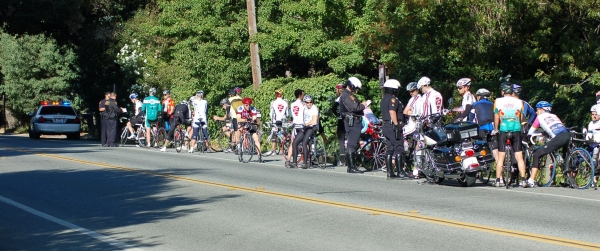
25 Woodside (CA) cyclists cited for running stop sign: The question to ask is: Were they unsafe?
…
The riders reportedly went through the stop sign …, making the right turn and heading west down Woodside Road.
[More about the Idaho stop and cars rolling on through stop signs as well.]
Continue reading “25 Woodside (CA) cyclists cited for running stop sign: The question to ask is: Were they unsafe?”