
An excerpt from Steve Magas article "COMPARING SENTENCES – THEY DON’T ALWAYS ADD UP"
"The Gerike case presents a good model for cycling clubs wishing to become involved in a criminal case. We followed the case from Day 1, attended and reported on the hearings, communicated with the Prosecutor, spoke out in the media, and when the time was ripe for our involvement, we flooded the judge with our letters describing the impact of Gerike’s actions on the cycling community. The letters clearly had an impact as the judge read from many letters at the sentencing hearing."`
Continue reading “A MODEL FOR CYCLIST INVOLVEMENT”
Analysis Finds Shifting Trends in Highway Funding: User Fees Make Up Decreasing Share

Fred Barnes: Americans Mainly Want to Stay in Their Cars
And they are basically asking why we can’t change this:
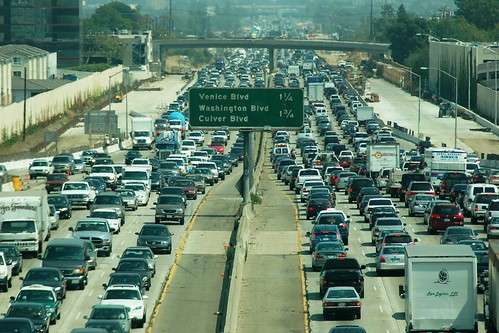 (by Atwater Village Newbie)
Into this:
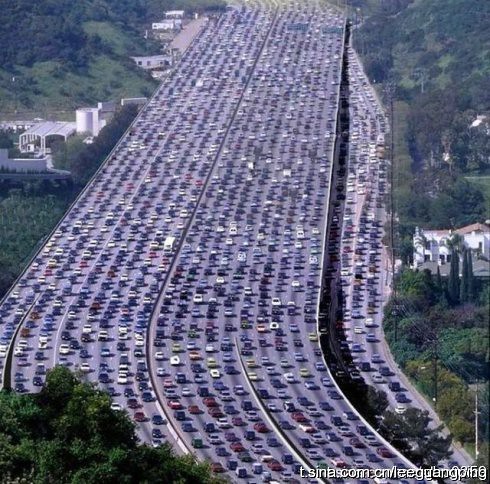 (copyright: Lee from t.sina.com.cn)
based on a tax that has not kept up with inflation nor has it kept up with improved fuel economy that puts in less money for the same wear and tear and the same demand for more space on the roads. (Not that it ever paid for all roads in full ever.)
This comment from from Streetsblog Capitol Hill by Ben Fried basically summaries the issues:
This is, basically, his entire argument: People just want to “stay in their cars.” We have zero interest in getting around any other way. According to Fred Barnes, we are perfectly content to drive and drive and drive, as long as we don’t have to put up with all the other people driving. If you believe that, then his cheerleading for highway construction makes a lot of sense.
If being inside our cars is what we’re really all about, by all means lets throw more money down the sinkhole of highway expansion. That will guarantee more quality time inside our cars. Then, a few years later, when we’re in our cars but not enjoying it so much because the new lanes are jammed with traffic again, we’ll repeat the whole expensive process.
But if we’d rather spend more time with our families and loved ones — or, you know, doing actual work instead of commuting — maybe we should try a different way of building our transportation system. According to public opinion research by Transportation for America, 57 percent of Americans would like to spend less time in their cars. Even with our highway-centric system, we’re already voting with our feet: These days, Americans are driving less and opting to walk, bike, and ride transit more than we were at the beginning of the decade.
Continue reading “Fred Barnes: Americans Mainly Want to Stay in Their Cars”
Bicycle travel on the rise, statistics say
Bicycle travel continues to grow in North America, according to research and anecdotal evidence from tour operators and tourism promoters in the United States.
Bicycle travel is becoming an increasingly visible part of the adventure travel market, which, according to a recent study issued by the Adventure Travel Trade Association, generates $89 billion annually.
Here are some points:
…
Continue reading “Bicycle travel on the rise, statistics say”
Could Restructuring the Gas Tax Fund the Transportation Bill?
This bit from Streetsblog Capitol Hill by Angie Schmitt caught my eye:
…
Sean Roche at Network blog Newton Streets and Sidewalks agrees with the impulse to restructure the gas tax, but says the proposal may not go far enough to bring fuel taxes in line with infrastructure spending:
Adoption of an ad valorem gas tax would be a step in the right direction. “Spending on road construction and maintenance grew almost exactly in line with the economy from 1994 to 2008 – a 102 percent increase.” As a consequence, “federal, state and local governments grew road spending faster than road revenues by borrowing more and by diverting general tax revenues to spend on roads.”
Ultimately, though, simply stemming the backward march of gas-tax revenue is not enough. We need to make up lost ground. We need to account for the impact of increased fuel economy. And, we need to capture more of the costs of driving from those who drive (or consume goods that have been shipped). One of the virtues of switching to an ad valorem gas tax, though, is that it has no immediate impact, but preps for the future.
It’s just math. Federal and state gas taxes are too low.
Continue reading “Could Restructuring the Gas Tax Fund the Transportation Bill?”
Thought for the day
From Florida’s gubernatorial campaign; AAA asks both candidates what they would do to boost highway safety.
Sink’s answer (in part) that she’d have FDOT study whether new road projects actually improved safety “over the ones they replaced.”
It’s time to get out of speed and capacity only issues and into improved safety for all road users. Sink also mentioned that she’d “seek to expand the percentage of federal safety funds that FDOT spends on bicycle and pedestrian safety programs.” It’s nice to see some candidates have some clue on what’s going on.
Continue reading “Thought for the day”
The Selfish Automobile
[B’ Spokes: Remember George Jetson’s car and how it folded into a suitcase? Let’s look at it in reverse and picture the space needed for a typical Single Occupancy Vehicle (SOV) of today unfolding at the the push of a button and expanding out like an inflatable raft in a department store. As it unfolds to the space it needs it does not stop at the size of a living room but keeps unfolding 9 more times till it’s the size of a typical house. That’s a lot of space just for one person, yet people seem to question why is there congestion when everyone “only” needs 2250sq.ft on the highway at the same time (rush hour) to move around “freely.” So I’ll highlight a bit from an article by Todd Litman:]
Space
Automobile travel is also space-intensive. The space requirements of different modes can be compared using time-area analysis, the product of space times time, measured in square-foot-minutes. Parking requirements depend on vehicle size. Travel space requirements depend on vehicle size and speed, since faster vehicles need more shy distance between them and other objects. For example, an automobile traveling at 30 miles-per-hour (mph) requires about 12.5 feet of lane width and 80 feet of lane length, or about 1,000 square feet in total, but at 60 mph this increases to 15 feet of lane width and 150 feet of length, about 2,250 square feet. The table below compares the time-area requirements of various modes for a 20-minute commute with 8 hours of vehicle parking. This indicates that driving requires about 15 times more space than bicycling, about 50 times more than public transport, and about 100 times more than walking.

Creating more bus, HOV and bike lanes is efficient and fair, because it allows users of these space-efficient modes (walking, cycling and public transit) to avoid delays caused by space intensive modes (single-occupant vehicles), and by making these modes more competitive it can attract travelers out of their cars which reduces traffic and parking congestion and parking problems. Yet, motorists often oppose such conversions. They only perceive congestion as a problem they face rather than a problem they cause, and they cannot imagine changing their own travel patterns to benefit others.
If motorists were generous and rational they would say things such as:
“Let’s create a transportation system that serves everybody.”
“Automobile travel does require a lot of road space, so it makes sense to favor more space efficient modes under congested conditions.”
“I support bike and bus lane development. Even if I do not use these facilities now, I benefit if other travelers shift to these modes, and I may want to use them sometime in the future.”
“I realize that the roads and parking facilities I use are costly to build and operate. It’s better that we pay for them directly through user fees rather than indirectly through subsidies that everybody must bear.”
[Read more for the link to the whole article.]
Continue reading “The Selfish Automobile”
Walk Friendly Communities encourages towns and cities to support safer walking environments
[B’ Spokes: I wounder if our new ranking of the 4th highest pedestrian fatality rate will encourage any towns in Maryland to apply?]
from Welcome to the Fast Lane: The Official Blog of the U.S. Secretary of Transportation by Ray LaHood
In an interview with Grist last week, I talked about livable communities. And one of the central features of livability is that you can get where you need or want to go without having to get into your car. For many reasons–the hassle of congested roadways, the need to reduce carbon emissions, the desire for better health–that’s what Americans have said they want.
Making a community safer for walking is one way to improve livability. And a new program called Walk Friendly Communities encourages towns and cities across the country to make safer walking environments a high priority.

The Walk Friendly Communities program will recognize communities that are working to improve a wide range of conditions related to walking, including safety, mobility, access, and comfort. It is sponsored by DOT’s Federal Highway Administration along with the Pedestrian and Bicycle Information Center and FedEx.
As FHWA Administrator Victor Mendez said, “Walk Friendly Communities will show how cities and towns across the country are creatively improving walkability and demonstrating leadership in addressing pedestrian safety concerns.”

Walking is one way of improving health through increased physical activity. But increasing the opportunities for people to walk in your community also offers other benefits.
How can Walk Friendly Communities help? The program offers a comprehensive assessment tool to evaluate community walkability and pedestrian safety. Questions in the online survey cover a community’s efforts in engineering, education, encouragement, enforcement, evaluation, and planning. The program will accept applications until December 15, 2010.
For some towns and cities, the assessment will tell you what you already know–your efforts have resulted in a walk friendly community–and you will receive national recognition for that achievement.
But even if you don’t think your community is “walk-friendly” yet, completing this assessment can help you confirm the successes in your area and pinpoint elements that need greater attention before you can establish the safest walking community possible.

At DOT, we are committed to giving Americans more choices that foster active, livable communities. And this initiative will do just that by improving pedestrian safety in areas across the country and providing a safe means of walking in and around their neighborhood.
If your community wants to work toward the livability Americans say they want, please take advantage of this terrific new program.
Cop Blocks Bike Lane To Ticket Cyclists For Not Using Lane
By John Del Signore
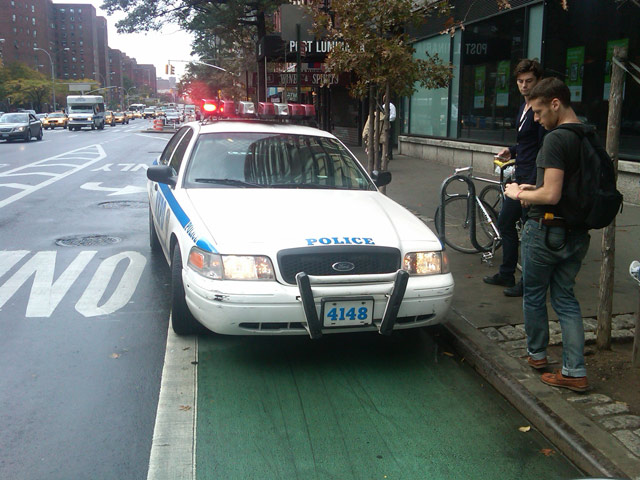
Sometimes the NYPD’s inanity is so perfect, so immaculately risible, that you just want to burst into applause and toss a bouquet of roses onto the hood of a squad car. Today is one of those days. According to a tipster, a cop parked in the bike lane on First Avenue near 23rd Street proceeded to write tickets for cyclists who weren’t using the bike lane, because they had to ride around him to get by. This is presumably part of the new crackdown on scofflaw cyclists, and hey—sometimes you have to destroy a bike lane in order to save it. (How come there’s never a clown cop around when you need one?)
…
Continue reading “Cop Blocks Bike Lane To Ticket Cyclists For Not Using Lane”
You know things are bad when…
When the contractor who was supposed to install the traffic signal to makes things safer for pedestrains gets killed as a pedestrian.
Continue reading “You know things are bad when…”