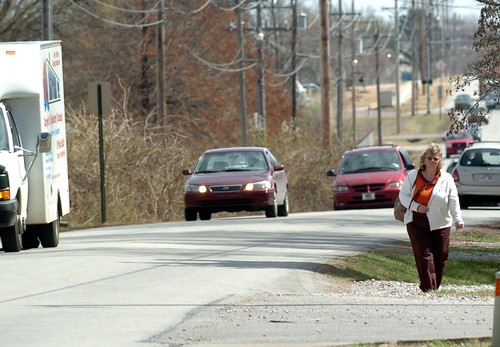
Blaming the pedestrian won’t solve the problem

From Transportation For America By Stephen Lee Davis

Walking in the ditch Originally uploaded by Transportation for America to Flickr.
If this woman got hit by car, it’s probably her fault, right? Photograph by Stephen Lee Davis/Transportation for America.

We noted on Twitter this morning a story in the USA Today about pedestrian deaths increasing in 2010, halting a decline that had been going on for quite a few years. The USA Today story took the angle offered from the head of a state safety association (Governors Highway Safety Association) that pedestrians are at fault for the increase in deaths. The Washington Examiner, not to be outdone, took some comments from the head of the association to baselessly suggest that more pedestrians are being killed because of the First Lady’s “Let’s Move” campaign to get more people active and walking to stem the obesity epidemic.

That’s right, it has nothing to do with things like 4 -and 6- and 8- lane arterials with no sidewalks and crosswalks a mile apart running through our communities. Or streets built without sidewalks. Or 55 mile per hour speed limits on roads where people need to walk. Or curved right turn lanes that allow cars to make turns at intersections at 30 mph. It has nothing to do with roads that are dangerous by design, leading to thousands of avoidable fatalities every year.

Automatically blaming the pedestrian is shameful and the GHSA should take their time to study the issue more carefully. Pedestrians are dying by the thousands, and it’s not because they’re using an ipod while crossing the street or trying to get more exercise at the First Lady’s urging. It’s because our basic choices about road design have left far too many without a safe place to walk, putting too many pedestrians in harm’s way.

We’d laugh at the GHSA’s silly suggestion, but we’re talking about a crisis that’s resulted in 76,000 deaths in the last 15 years. It’s no laughing matter.

UPDATE: The GHSA told the Atlantic that they were misquoted by the Examiner. They don’t refute a possible link, but they do say they support Michelle Obama’s program, adding that if more people are walking, they need to be aware.

Harsha said her primary concern for pedestrians was the increased use of electronic devices like iPods that can block out sound and make walkers unaware of oncoming traffic. The organization has received anecdotal evidence of pedestrian injuries caused by people walking into traffic.

It’s good they clarified, but it still sounds like they don’t quite grasp the main cause of death for pedestrians: Roads that are dangerous by design and unsafe for pedestrians. “Distracted” pedestrians aren’t the real culprit here.

TBD, a local DC news site, shared the pitch that they got from the GHSA, which is likely where the “Let’s Move” connection originated:

“Why the increase? We don’t really know but speculate that it could be a couple factors. One is the possible increase in distracted pedestrians and distracted drivers. We’ve been focusing on the drivers, but perhaps we need to focus some attention on distracted walkers! Additionally, Mrs. Obama and others have been bringing attention to ‘get moving’ programs, so perhaps pedestrian exposure has increased.”

Continue reading “Blaming the pedestrian won’t solve the problem”

Promoting car centricity on Facebook – epic fail

Excerpts from "I Told Congress About Transportation":
"Dedicated Bicycle superhighways (like in London) connecting suburbs to downtown business districts."
"we need to provide more efficient public transportation, that will reduce our need to use our cars so much and reduce our use of foreign oil. … Secure cross country bicycle lanes should also be implemented."
"Firstly, increased transit, bicycle, and pedestrian infrastructure."
"I’ll keep it simple – highspeed rail, bike facilities, ped facilities, ADA facilities and wide shoulders on thousands of miles of rural roadways."
"Work with road designers and builders as well as vehicle manufacturers towards a goal of zero fatalities."
"1. Make our existing urban, suburban, and rural roads more bicycle and pedestrian friendly by calming traffic, and installing generous bicycle and pedestrian infrastructure.
2. Develop our existing communities into bicycle and pedestrian friendly mixed-use residential/commercial/industrial villages connected by rail transit.
3. New and/or improved rail transit lines should be given a higher priority than highway capacity increasing projects. "
"It’s time we stopped wasting money on a dysfunctional system and started working on better, more efficient alternatives. We need to spend dramatically less money on new highways and dramatically more on transit, intercity rail, and bike/ped facilities. "
"Being a bicycling commuter I am concerned about my safety as I travel on roads not made to be shared with bikes"
"I do agree that local bike routes are getting to be more and more necessary. I see far too many bikers taking over the road and antagonizing (yes – antagonizing – like deliberately blocking motor vehicles and not even attempting to share the road) drivers partly because there is no safe place for them to ride. I want the bikers to have a safe place to ride so the road can be shared."
"COMPLETE STREETS! "
"Severely reduce our dependence on the personal automobile. … The idea of the one person to one car is a long failed notion."
"I would love to see more metro trains that link cities together,"
"Unfortunately, the RTP [Recreational Trail Program] fund is in jeopardy…"
"though I would prioritize safe and efficient bike/pedestrian lanes designed to support bike and pedestrian commuters, over high speed rail."
"Bike lanes; Rapid transit between cities"
"Please grant full funding for bike trail projects, pedestrian safety projects, public transit improvements and high speed rail proposals in the midwest. We need to create better non-car options for getting around. "
"And, I really hate feeding the petro fatcats, so I prefer my bike during the better times of the year."
"We’re never going to get out of the gas gussling, space consuming vehicles if someone doesn’t make a move toward the future."
"Focus: Walking/Biking/Public Transportation,commuter rail.. to reduce traffic congestion, air pollution and improved public health."
"I am retiring from highway engineering because we are not building anymore and cannot deliver the needed highway infrastructure to our travelers. It is simply too frustrating to spin our wheels and spend lots of money and time satisfying the whims of our Federal Highway Administration division officials. Send us some intelligent, thoughtful, experienced and customer-oriented professionals who will partner with state highway agencies.

The surface transportation system needs to provide for bicycles, pedestrians and assisted mobility users within cities and for inter-city travel; commuting and recreational travel should be more readily available to these users."
"I would like to see a vast expansion of Safe Routes to School. I would like to see more of a focus on transit, including high speed rail. Designing our nation around the automobile have made our cities look atrocious, our children so overweight that many have developed diabetes and cannot even serve in the military, and our roads are so hostile to bicyclists and pedestrians that many of us thank god anytime we make it back from the grocery store."
"That said, the new bill should disfavor highway expansion. … Focus more resources toward urban areas where 81% of the population lives. Infrastructure repair, mass transit and inter-urban forms of transportation like streetcar, BRT and bike and ped infrastructure can do much more than ex-urban highway expansion to provide the kind of access to destinations people are really looking for."
"Please make our existing urban, suburban, and rural roads more bicycle and pedestrian friendly by calming traffic, and installing generous bicycle and pedestrian infrastructure. Emphasize bicycle and pedestrian friendly mixed-use residential/commercial/industrial communities by connecting them via rail transit. Prioritize those new and/or improved rail transit lines over highway capacity increasing projects."
"I would like to see alternatives to driving and flying be accessable to everyone, and to be the transportation mode of choice in urban areas. I personally ride my bike or take the bus to work everyday. I would love to see more people join me."
"We need complete streets where all uses are fairly and appropriately accommodated and death should no longer be acceptable consequence of accommodating motoring faster then what’s prudent."
"DC’s Capital Bikeshare system has saved me time on my multi-modal commute and gotten me a bit of exercise to boot. Please consider funding such partnerships to provide other urban residents with healthy and cheap transit options for short or medium distances. "
"Your next priority should be light commuter rail to connect large urban areas with their surrounding communities"
"Share the road. We need complete streets so that we can chose our mode of transportation–walk to the bus, ride a bike to the bus, drive a car, take a train. … Say no to the old gang at the Road Gang in DC."
"City by city there is a struggle to implement alternative transportation networks. … funding to improve transportation as a whole, more options would be provided to people and the most efficient forms of transportation could be implemented!"
"we need more and better public transportation."
"Please help us get to work by providing reliable public transportation."
Continue reading “Promoting car centricity on Facebook – epic fail”

I told congress we want more concideration for cars.

image
This is going around car centric circles so it would be a great idea if bicyclists would join in. Personally I am rather disappointed in AASHTO’s flier in terms of not stressing alternate transportation and in asking for wider lanes. Wider lanes encourage speeding and studies show a higher crash rate, if anything we need to encourage more 10′ lanes and leave the wider lanes for the expressway.
image

And sorry this does seem to be Facebook only: I Told Congress About Transportation

To help bribe you Baltimopre Spokes is on FaceBook and you can follow me on FaceBook and my (sometimes) other interests besides bicycling.

Get Rich While Reducing Emissions: Smart Growth Keeps Looking Smarter

from Streetsblog Capitol Hill by Tanya Snyder

Just when you may have been looking for ways to counter that Pew report which poo-pooed the environmental impacts of transit and smart growth, here’s more evidence that reducing driving has an essential role to play in meeting economic and environmental goals: A new report from the Center for Clean Air Policy concludes that compact development will build wealth and cut carbon emissions.

Compact urbanism even works in the suburbs, like Bethesda, Maryland. Image: ##https://maryland.sierraclub.org/montgomery/growth_what.html##Maryland Sierra Club##

Compact urbanism can work in the suburbs, like Bethesda, Maryland. Image: Maryland Sierra Club

Growing Wealthier: Smart Growth, Climate Change, and Prosperity” starts with the simple assertion that accessibility – “bringing origins and destinations closer together” – is, after all, “the very reason that cities exist.”

“You want to have your choices nearby so you can meet your daily needs as efficiently as possible,” said report author Steve Winkelman.

By separating residential areas, commercial services, and places of employment, suburban planning requires that people travel long distances to meet their needs. All those miles used to be viewed as a measure of economic progress.

“[Vehicle Miles Traveled] and GDP have grown concurrently since World War II and in lock step for much of that time,” the report states. But around 1996, GDP began growing faster than VMT, and, according to the U.S. Chamber of Commerce, “the importance of travel as a component of the U.S. economy has been declining since the early 1990s.”

Indeed, CCAP’s research shows that states with lower VMT per capita tend to have higher GDP per capita.

Excessive travel is more likely to be an economic detriment than a benefit. Ironically, GDP counts as economic productivity many of the counterproductive aspects of motorized travel, such as fuel consumed waiting in traffic jams, oil spills, vehicle repairs and medical treatment resulting from collisions, costs of air pollution, and defense operations to protect U.S. petroleum interests around the world. In fact, many costs of sprawling land use patterns (particularly increased infrastructure) themselves boost GDP figures.

The authors also urge us to distinguish between economically productive travel and what they call “empty miles.” It’s like differentiating between empty calories and nutrition.

“A lot of driving that most people are doing nowadays is not helping them economically,” said report author Chuck Kooshian. “Although the VMT has been going up per capita, as we’re making trips to the grocery store five miles to get some milk, and we’re taking the kids out driving to go trick-or-treating, and driving to the park to walk our dog, this is not helping the average household economically. It might be helping the Saudis.”


Continue reading “Get Rich While Reducing Emissions: Smart Growth Keeps Looking Smarter”

How much flexibility is there in the Manual Of Uniform Traffic Control Devices? [video]

Highlights: Portland has 15mph speed limits to facilitate the mixing of cyclists with motoring traffic. They eliminated the pedestrian “beg” button downtown. In looking up some numbers it is very interesting to note they had 8 pedestrian fatalities vs our 16 pedestrian fatalities. Pedestrians are 19% of their traffic fatalities and ours is 42%.

The Manual: The Movie from Cantankerous Titles on Vimeo.

Quote of the Day: Jan Morris on Motorcades

by Cap’n Transit
From Coast to Coat: A Journey Across 1950s America by Jan Morris, originally known as As I Saw the U.S.A. by James Morris, about motorcades in Manhattan:

And there in the recesses of the grandest car can be seen the distinguished visitor, opera singer, or diplomat or bronzed explorer, shamefully delighted at being able to ignore the traffic rules. I rode in one such a cavalcade, and found that the psychological effect can be disturbing. A mild little man sharing my car was soon hurling vicious abuse at the less agile of the pedestrians, and the wife of the distinguished visitor fainted.

It makes me wonder: when almost all drivers are able to ignore the laws against killing pedestrians and cyclists, and dismiss all enforcement efforts as “revenue generation,” what are the psychological effects?

Continue reading “Quote of the Day: Jan Morris on Motorcades”