
Moral of the story: Always make sure you get contact information from the driver and witnesses. Never count on the police to act in your best interest.
https://www.tbd.com/blogs/tbd-on-foot/2011/02/arlington-cyclist-gets-doored-then-hosed-8594.html
Urbanism in the Age of Climate Change
On a club ride I went on last weekend one of the cyclist picks up a handful of show and says sarcastically "I’ve got your global warming right here." But as my tag line on my email says: – Global warming, increasing obesity rates, traffic congestion, dependence on foreign oil, leading causes of premature death and the economy… if only there was a common solution.
I don’t think proving global climate change is withing the scope of this blog but solutions to major issues of the day that include promoting more bicycling are. So if you don’t believe in climate change just substitute another issue, they are all interrelated. So a quote from the linked article:
"But for the past fifty years, our economy and society have been operating on the premise that “more is more” and “bigger is better”: bigger homes, bigger yards, bigger cars with bigger engines, bigger budgets, bigger institutions, and, finally, bigger energy sources. In contrast, urbanism naturally tends toward a “small is beautiful” philosophy. This then involves trade-offs: less private space but perhaps a richer public realm; less private security but perhaps a safer community; less auto mobility but more convenient transit. Compact development does mean smaller yards, fewer cars, and less private space for some. On the other hand, it can dramatically reduce everyday costs and leave more time for family and community. The question is not which is right and which is wrong or that it must be all one way or the other—urbanism works best with blends. The question is how such trade-offs fit with our emerging demographics, our desires, our needs, our economic means—and perhaps our sense of what a good life really is."
Continue reading “Urbanism in the Age of Climate Change”
Adding insult to injury
by Doug Landau
Having run, biked and driven past the W&OD Trail crossing at Sterling Park Drive, Herndon bike injury lawyer has seen a number of "near misses" at this location. A Sterling Park Virginia bike accident results in the biker getting crushed and then getting a ticket, despite being waved on by at least one car driver. The local biker contacted Abrams Landau after being struck by a car in Sterling Virginia and being issued a Traffic Court Summons at the hospital. Member of the Landau Law Shop sports injury team had heard of other cyclists and pedestrians receiving their citations at the hospital, but it always strikes Herndon lawyer Doug landau as "adding insult to injury," especially where permanent injuries and disability are likely. In this case, as the local biker was headed West on the W&OD Trail from Herndon toward Sterling Virginia, he came to Sterling Virginia and then two lanes of motor vehicles heading South toward Route 28 (Sully Road) in Loudoun County.
There was no traffic in the first two lanes, so the cyclist crossed safely to he center grass and paved strip. the car in the first Southbound lane stopped and waved him and another cyclist to proceed. The other cyclist proceeded safely to get back on the W&OD Trail, however the local biker was struck broadside in the 4th lane by a car that never saw the athlete or his bicycle. The local cyclist was taken to the emergency room after this "T-bone" crash with fractures, lacerations and permanent injuries and scarring. However, the police officer charged the biker. Citing the lack of certain reflectors; lights during the evening ride and failure to wait for both lanes of Southbound traffic to stop and signal that it was safe to proceed, the Virginia law enforcement authorities charged the bike rider after the crash.
….
Continue reading “Adding insult to injury”
Take a Pass
By Bob Mionske, J.D.
A common misconception motorists have is that cyclists are slow. Of course, an automobile can reach higher speeds than a bicycle, but that’s on the increasingly mythical open road. Around town, we regularly demonstrate that cyclists are capable of keeping up with cars and often able to easily pass a congested lane of traffic. But this raises the question: What does the law say on the subject? The rules, as always, differ depending on where you are riding and whom you are passing. But let’s take a look at a few common situations.
Bike Lane
It seems too obvious to state, but a cyclist sprinting past others is dangerous, if not illegal. You should pass other cyclists deliberately and at a safe distance (the closer you are, the slower you should go). If the path is so tight that you can touch the person you’re passing, proceed even more cautiously. Also, the law may require you to audibly warn others before passing; for courtesy, you should do this regardless. Never pass on the right–you may cause a collision. Even though it’s a bike lane, watch for cars: In most states, motorists must merge into the bike lane before turning right. If there is a car in the bike lane, cyclists are legally permitted to pass it by moving left, into the vehicular lane, and carefully merging back in once it’s safe to do so. Of course, pay attention to what traffic is doing regardless. In Oregon, drivers are not allowed to merge into the bike lane, and must instead yield to cyclists before turning, but riders there should still tune in to activity all around them. For your own safety, don’t try to pass right-turning vehicles by cutting in front of them in the bike lane; slow down and let the driver turn.
Sidewalk or Multiuse Path
When you’re riding on the sidewalk, you are required to yield to pedestrians– assuming it’s legal to ride there in the first place. On a multiuse path, you’re required to follow rules regulating use, which are usually posted and typically address speed and right-of-way. Again, if you can touch the cyclist or pedestrian you are passing, you are too close for any significant speed. Move farther left, or slow down, and give an audible warning before passing.
Wide Road
Typically, if a lane is wide enough to share with a motorist and you are not moving at the speed of traffic, you must ride as close to the right as is safe (see BICYCLING.com/whereyoubelong to learn more). The general rule is that vehicles cannot pass on the right–but if the drivers to your left are traveling at a slower speed than you are, you don’t have to slow down to avoid passing them. Because the law requires you to share the lane, it also acknowledges that you will sometimes pass other vehicles, just as other vehicles will pass you.
Narrow Road
When lanes are too narrow to safely share with a motorist, you are allowed by law to take the full lane. If, say, a driver in front of you is slowing to park or enter a driveway, you may make a legal pass to the left, just as if you were driving a car.
Research and drafting provided by Rick Bernardi, JD.
Transportation Reformers Applaud Obama’s Six-Year Transpo Plan
from Streetsblog.net by Angie Schmitt
A fix-it-first policy for roads. More support for livability programs. Additional transit investment. Competitive infrastructure grants. In his new six-year, $556 billion surface transportation proposal, President Obama is hitting all the right notes with transportation reform advocates.
As part of his 2012 budget proposal — released yesterday — the President put forward a plan that would double investment in transit, give a boost to bicycle and pedestrian infrastructure, and generally chip away at policies that have led to billions going to waste on highways to nowhere.

Yeah, baby: The President’s 2012 budget proposal was greeted like a star by transportation reformers. Photo: The Globe and Mail
Across the Network, the plan is getting rave reviews.
Transportation for America‘s James Corless released a statement saying:
The Administration’s visionary reforms recognize where we are at this moment in history: Having built the world’s best highway and bridge network, we have to focus on preserving those aging assets while we build the missing pieces of a modern system that allows people and goods to get where they’re going cheaply, conveniently and safely.
Yonah Freemark at the Transport Politic concurred:
The reforms announced by the Department of Transportation indicate how the Administration wants the Congress to move forward on a funding reauthorization bill, and the measures proposed make sense. The Highway Trust Fund would transform into the Transportation Trust Fund, providing new, specified accounts for highways, transit, high-speed rail, and an infrastructure bank (currently there are only highway and transit accounts). Transit agencies would be allowed to use some of their federal funding for operations, something that is not allowed under current federal guidelines. And the various grant-providing programs currently offered by Washington would be simplified. These would all be meaningful, useful improvements over the existing situation.
The NRDC‘s Deron Lovaas applauded the administration for thinking big:
This is a big, big budget proposal. And it should be. Transportation is the second biggest expense for most Americans, ahead of food and health care. The Administration is swinging for the fences on this one, and they’re going to get pushback from some conservatives. But transportation is one issue where both parties have a history of working together, and it’s an issue where the public expects bipartisan cooperation.
As Tanya noted yesterday, and as many bloggers alluded to, the big questions remaining are how the President’s proposal will be received in the Republican House, where cutting discretionary spending is all the rage, and in the Senate, which still rests in Democratic hands. Across the Network, bloggers had mixed opinions about the chances for bipartian cooperation on the critical issue of the nation’s infrastructure. Corless of T4A noted that the American public has indicated wide support for increased infrastructure spending. He added: “The task now is for the President and Congress to engage in the bipartisan problem-solving Americans expect in order to find ways to pay for the jobs-sustaining infrastructure they deserve.”
Continue reading “Transportation Reformers Applaud Obama’s Six-Year Transpo Plan”
Hybrid Cars More Dangerous to Pedestrians and Cyclists
Straight Outta Suburbia focuses on a new report [PDF] from the National Highway Traffic Safety Administration which found that hybrid vehicles were involved in “significantly” more collisions than vehicles with internal combustion engines, under certain circumstances. Some car companies, including Nissan, have begun seeking engineering solutions to the problem, including innovations like an artificial sound system. But better planning for less car dependent cities is the safest solution, the blog notes. “It’s very difficult to get a handle on the problems caused by cars just by trying to improve the cars themselves. One solution (hybrid drive train) can create another problem (higher pedestrian and cyclist risk).”
Continue reading “Hybrid Cars More Dangerous to Pedestrians and Cyclists”
City Council Bills to Release Traffic Data Pass Committee Unanimously
Something I would like to see in Maryland. Read more about NYC “Saving Lives Through Better Information” bill
Continue reading “City Council Bills to Release Traffic Data Pass Committee Unanimously”
What should greater investment on transportation net us in the end? What would the benefits be?
from new bipartisan poll from the Rockefeller Foundation:
Voters’ top goal by far is “safer streets for our communities and children.” 57 percent say this should be one of the top-two priorities if more money is invested in infrastructure. The second-highest priority for voters overall (32 percent) is “more transportation options.” In addition, 85 percent agree that “spending less time in traffic would improve quality of life, make communities safer, and reduce stress in people’s daily lives.” Moreover, the vast majority also believe the country (80 percent) and their own community (66 percent) would benefit from an expanded and improved public transportation system.
Continue reading “What should greater investment on transportation net us in the end? What would the benefits be?”
Who cycles in the Netherlands ?
from A view from the cycle path – David Hembrow
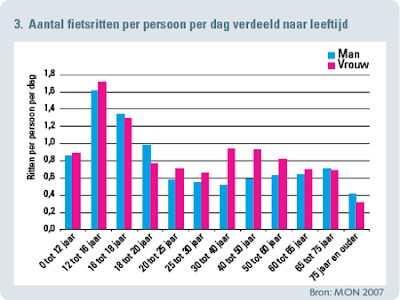 I’ve mentioned before that in the Netherlands, everyone cycles. This graph shows how cycling rates vary with age and sex within the Netherlands, expressed as the average number of cycle journeys per day made per person.
It shows a number of things: that cycling is very popular with school age children, for instance, and that it drops off a bit for working age adults as for some the commute is “too far” by bike. You’ll also see that women in their 30s, 40s and 50s cycle more often than men. This is due to women being more likely to be at home looking after children than their male partners. As a result, they more often cycle with young children to school, or make shopping and other utility trips by bike. This is what leads to the Netherlands uniquely having 55% of trips overall by women.
Cycling stays with people through their entire life. Even the over 75s make an average of around 0.3 trips per day by bike.
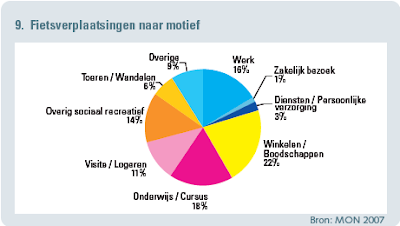
Here we see the reasons for bicycle journeys. Only 16% of all cycle journeys are commutes. The largest percentage, 22%, are shopping trips, 18% are school journeys, 14% are social, and 11% are to go visiting.
This level of cycle usage, across both sexes, all ages, and for all purposes, requires infrastructure which has a high level of subjective safety.
These figures came from the same source as last week’s post, the Fietsersbond. Marc has also written about these statistics.
The reality of an automobile-centric mobility paradigm
from Rebuilding Place in the Urban Space by Richard Layman
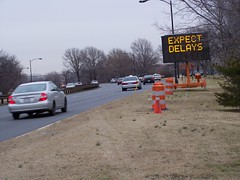
Expect Delays (due to construction) sign, George Washington Parkway, Virginia
Originally uploaded by rllayman
In an interview with Jane Jacobs, after the publication of the book The Nature of Economies, with regard to automobile traffic, she said that mostly people asked the wrong question…
The Wrong Question
Why aren’t there enough roads?
The Right Question
Why are there so many cars?

Continue reading “The reality of an automobile-centric mobility paradigm”