The wrong answer
The right answer
Jump off from Ad Nauseam Double Feature: Safe Subaru vs. Deadly Dodge which makes another good point.

Biking in Baltimore
The wrong answer
The right answer
Jump off from Ad Nauseam Double Feature: Safe Subaru vs. Deadly Dodge which makes another good point.
from Streetsblog New York City by Angie Schmitt (highlight)
We’ve engineered our entire transportation system around an activity which requires increasing amounts of unproductive time, unless you are distracted. – Keri at Commute Orlando
Continue reading “Car Companies Vie for Supremacy in Distracted Driving Arms Race”
An 83-year old woman who lived alone in the town of Ishinomaki, Japan, escaped the tsunami by fleeing on her bicycle.
When she heard about the tsunami warning, she did the first thing that came to mind and jumped on her bicycle. She prides herself on her health and fitness, she said.
…
Continue reading “83-Year-Old Japanese Woman Escapes Tsunami — By Bike”
A great article from the Grist, the highlight:
…
It’s a huge and
incredibly wonky document. But one part of it jumps right out. In it, Litman
takes on people who object to paying higher gas taxes, tolls, or parking fees (emphasis mine):
Critics are wrong to claim that raising
road tolls, parking fees or fuel taxes is unfair. Does charging admission at movie theatres constitute a “war
on film viewers”? Does charging for bread constitute a “war on eaters?” Motor
vehicle user fees only finance about half of roadway costs and a much smaller
portion of parking facility costs; the rest is financed indirectly through
general taxes (for local roads), higher retail prices (for business parking),
lower wages (for employee parking), and higher housing costs (for residential
parking) (Litman 2009; Subsidy Scope 2009). This funding structure forces
people who drive less than average to subsidize their neighbors who drive more
than average. Automobile travel also imposes other external costs, including
congestion delays, accident risk, pollution emissions, and various economic and
environmental costs from fuel consumption. North American fuel taxes are among
the lowest among developed countries and have not been raised to account for
inflation during the last two decades. These low user fees exacerbate traffic
and parking congestions. The pricing reforms that critics call “anti-car” are
often the most effective way to address the problems motorists face.
The truth is, as Litman points out, that
no one is calling for an obliteration of cars from the American landscape. Reform
advocates instead want policies that give more people more choice — which
might be nice, considering the way gas prices are going.
…
Continue reading “The latest battle in the nonexistent ‘War on Cars’”
from Boston Biker
This is awesome…
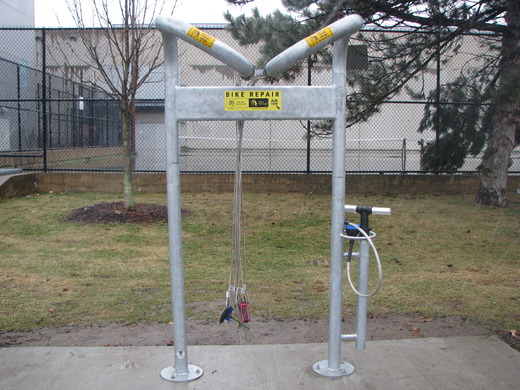
Cambridge Transportation Program Manager Cara Seiderman said the city has installed the bicycle repair stations in Harvard Square and outside the main library in the past two weeks. Another center was installed at Fresh Pond late last year.
“It’s a way of supporting and making it easier for people to bike,” Seiderman said.
The stands provide tire gauges and pumps, Allen wrenches and a few other tools that enable cyclists to make minor repairs, such as adjusting seats or handlebars.
Each station cost the city about $1,000 and Seiderman said the city got the idea from MIT which has already installed repair stations around its campus.
The installation of the repair stations comes as the city has seen a growing number of people riding bikes through Cambridge. A study conducted by the city estimates that the number of people bicycling in Cambridge more than doubled between 2002 and 2008, based on a study of the number of cyclists counted traveling through 17 different intersections. Seiderman said the number has continued to rise since 2008.(via)
For almost free (as far as these sort of things go) you can now stop by two locations in Cambridge and pump up your tires, fix a flat, and several other easy repairs. Thanks Cambridge, Boston you paying attention?
I think this is a great idea, and hope to see a couple of these near some popular bike parking spots all over town.
Continue reading “Cambridge Installs Self Help Tool Stations”
I think this is just shameful and happening in Portland, OR no less. In reaction to several pedestrian deaths where the bus violated the pedestrians right-of-way the bus service decides to install a pedestrian warning device and as it is currently functioning it should be saying something along the lines of “If you can hear this you are being run over by a bus.” at a price tag of over $4,000 per bus.
It’s not clear what is more outrageous, the price tag or trying to put responsibility on the pedestrians to get out of the way of a bus. There is no doubt that trying to shot the gap while making a left turn with a bus is challenging but as in all traffic maneuvers the rule should be “don’t do it till it is safe.” The reaction should be for buses to wait for a yellow clear the intersection phase and take the time to do a left turn safely then this idiotic voice reprimanding law abiding citizens.
Continue reading “Spread of the "Don’t be dead right" cancer”
from Streetsblog.net by Angie Schmitt
…
"Kaufman stopped and waited at the scene for police to arrive. Broward police said in a release the 79-year-old driver did not appear impaired and had not been speeding."
Oh, he wasn’t speeding or impaired? What a relief. We’ll just scrape this guy off your hood and you’ll be running along in no time.
Continue reading “Another Pedestrian Killed on South Florida Streets”
from Commute by Bike by Tom Bowden
…
One troublesome argument that seems to be gaining traction is along the lines of, “Why should cycling be a federal issue? Shouldn’t it be a state and local issue?”
Of course that is conservative code talk for, “We don’t want to fund it, because we will get more votes with bigger projects.”
My response would be, True, it should be a local issue, and when all of you ear-marking politicians stop paving every square inch of our local communities with federal highway subsidies, we’ll be happy to take responsibility at a local level. But for now, we just want to level the playing field a little. And after all, for every federal dollar you spend on properly designed cycling infrastructure (and I don’t mean multi-use paths to nowhere), you can ultimately de-fund $10 worth of auto infrastructure. De-fund is a good word to use with Republicans and conservatives.
…
At one point in a briefing session on Wednesday, the constant repetition of the “wear a helmet” mantra got a little too much for me. It was cited that in nine out of ten cases of cyclist fatalities due to head trauma, the cyclist was not wearing a helmet. I posed the question, “If that is a justification for all cyclists to wear helmets, than what about the 99.999% of motorist head trauma fatalities who were not wearing helmets? Shouldn’t we start a campaign to make them wear helmets too?” I continued “I’m not anti-helmet–I’ve crashed with a helmet and without a helmet–but helmets are not the only answer, or even the most important answer. As long as we keep on putting so much emphasis on helmets as the most important safety issue, we perpetuate the myth that cycling is inherently dangerous. Cycling is not inherently dangerous, cars are inherently dangerous to cyclists, pedestrians and motorists. But all this helmet focus does is place the responsibility for safety on cyclists, rather than on the root cause of the problem, which is unsafe driving.”
I probably didn’t put it quite that well – I was actually shaking a little, anticipating a backlash to my politically incorrect rant. But to my surprise, there was applause and even a few shouts and whistles–the good kind. It was my fifteen seconds of attention, if not actual fame.
…
Continue reading “The Bicycle is the Answer. What was the Question?”
When it comes to police enforcement errors, DC and Baltimore have something in common. I’ll note this paragraph from Greater Greater Washington:
"Some of the commanders admitted that interactions with pedestrians can be more confrontational than with motorists. This, they said, often happens because pedestrians are more likely to challenge the officer than drivers."
IMHO This is more likely because the police get the laws wrong when dealing with traffic laws and non-motorized individuals.
Continue reading “To reduce enforcement errors, MPD wants traffic division”
from CenterLines, the e-newsletter of the National Center for Bicycling & Walking.
-> According to a Mar. 7th L.A. Times article, "Older drivers may have a breadth of driving experience working for them behind the wheel. But a new study finds they tend to have a narrower field of vision than younger drivers and often miss developments on the curb or sidewalk that could demand their attention. The study, published online Monday by the journal Accident Analysis and Prevention, found that drivers over 65 were half as likely to notice pedestrians near or moving toward the street as were experienced drivers between the ages of 28 and 45. Placing the two groups of drivers in a simulator and in front of videos taken from a driver’s eye view, researchers from Ben-Gurion University of the Negev found that older drivers took longer to respond to road hazards as well."
"And compared to younger drivers simulating a drive through a variety of streetscapes, those over 65 tapped on their brakes in response to a ‘roadside hazard’ about half as often, suggesting either that they did not see it or that they did not consider it something they needed to attend to. The good news (unless you’re driving behind one of these motor vehicle operators and you’re late for an appointment) is that the older drivers drive more slowly — about 20% more slowly — perhaps to compensate for shortcomings in their peripheral vision and attention…"
Source: https://tinyurl.com/6dnjgp6
-> "’Motor vehicle crashes are still the leading cause of death for from ages 3 through 34. They are taking our youngest people away. There are 93 deaths every day, one death every 16 minutes."
— Dr. Federico Vaca, professor of emergency medicine, Yale School of Medicine
https://tinyurl.com/6eapseb