
By David Heymsfield
Former Staff Director, House Committee on Transportation and Infrastructure
Many prior postings in this blog have made strong arguments that an increase in federal support for transportation is a sound investment that will promote economic efficiency, growth in employment, and quality of life. If these arguments do not carry the day, there will need to be careful consideration of the rationale we will use to determine the appropriate level of federal investment in transportation.
I find it difficult to understand the rationale followed in Chairman Ryan’s budget. He concludes that highway and transit funding should be reduced to the amount of the revenues that are now received by the Highway Trust fund from taxes established in 1993. This approach would appear to reduce highway and transit funding by 30% or more — much larger reductions than those proposed in many other programs that would be frozen at 2008 levels. For example, the aviation bill recently passed by the House included reductions of about 6%.
Highway and transit trust-fund revenues come primarily from a gas tax last increased in 1993. The increase was first used for deficit reduction and was only added to the Trust Fund in 1998. The 1993 tax is not indexed for inflation and will yield less revenue if fuel efficiency improves. Why should the revenues which this tax produces be the amount at which we will support federal transportation programs?
From the beginning of the trust fund in 1956 through 1998, trust fund taxes were periodically adjusted to the level that would produce the revenues needed for a sound program. Program needs were determined first, followed by establishing revenues to meet the needs. The 2012 budget proposal reverses the process and uses the revenues produced by a 1993 tax to determine the level of the program. Had the Congresses of 1993 and 1998 realized that they were capping the highway and transit programs forever, they would have given it a lot more thought.
Continue reading “Reduced Transportation Investment”
Manner and Fault in Bicyclist Traffic Fatalities: Arizona 2009

Abstract
Traffic records for all bicyclist fatalities occurring in Arizona during the year 2009 were categorized and listed according to manner of collision and assignment of fault. Primary results are that 11 of 25 fatalities (44%) were determined to be the fault of the cyclist; while 14 of 25 (56%) were the fault of a motor vehicle driver. The most common manner of collision is when a driver strikes a cyclist from behind.
Continue reading “Manner and Fault in Bicyclist Traffic Fatalities: Arizona 2009”
The way to promote bicycling is to make it mundane
by Bagehot
…
I want van drivers to stop trying to kill me as much as the next rider, but I don’t think confronting them into good behaviour is likely to work. I want bicycling to become boringly normal and un-rebellious, so that you don’t need Lycra and an attitude to take it up, and the roads become so infested with us that car drivers simply have to adapt to us and town halls realise that providing better cycle lanes might be a vote winner. I have ridden in countries such as Denmark and the Netherlands where cycling is a joy, and the secret is that grannies and men in suits are a part of the throng, and that glassy-eyed mother on the school run has her brood of children strapped into a bicycle built like a wheelbarrow, not a car built like a tank.
Continue reading “The way to promote bicycling is to make it mundane”
Does it have to fold to be a portable bike?
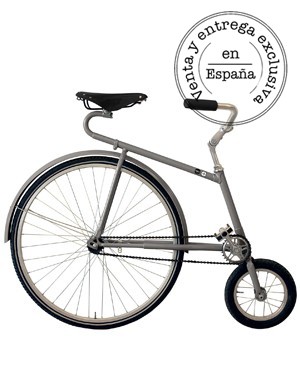
My first thought was to wounder how well this would go over on the MARC train.
Continue reading “Does it have to fold to be a portable bike?”
BIKE LANE SHORTAGE
A British national survey by cycle insurance provider, Cycleguard, finds that 83 percent of cyclists have bike lanes for less than half of their daily commute and 53 percent of cyclists only have bike lanes for one-quarter of their daily commute. Cycleguard has since called for the creation of more bike lanes in Britain.
Continue reading “BIKE LANE SHORTAGE”
Smarter
From Google Maps Bike There
…
I stumbled across a website/company doing a couple of interesting things — fatamerican.tv. In particular, I liked their play on the Smart Car. Here is the Smart Car logo:

And here is the cool t-shirt design from fatamerican.tv:

What may be even cooler, though, is that the explanation of the design is on the inside of the t-shirt:
The “Smart Car” isn’t smart; it gets the same fuel efficiency as other economy cars but only seats 2 passengers. When compared to bicycles, all cars tend to look down right idiotic. Where’s the logic in working tons of hours to pay for a car to get to work to pay for a car? What’s the sense in driving to the gym to pay a membership to get some exercise?
Move within biking distance to work, sell your car, cancel your gym membership and start living smarter. Increase your quality of life while not contributing to the political, environmental, social calamity created by the world’s dependency on oil.
In a Split Second
By Keri in Commute Orlando
The director of Bike Florida, Ron Cunningham, has written a poignant post about the death of a cyclist during last week’s event. Robert Paul King was killed by a distracted driver who drifted into the shoulder:
Mr. King was killed after being struck from behind by a fast-moving pickup truck. The driver, a young man, reportedly told police he had dropped his cell phone and was reaching down to retrieve it when his vehicle drifted into the marked shoulder where Mr. King had been cycling.
Rather than rant against the driver, Ron says this:
It takes only a split second of inattention to transform the mundane into the terrifying. I am certain that the young man who struck down Robert Paul King in an instant of distraction would dearly love to have that split second back. But he can never get it back. And now another cyclist is gone and another young driver’s life has been altered forever.
That is a picture of reality we would all do well to internalize. If we were all mindful of this possibility while operating our vehicles, there would be a lot less carnage on our roads. Unfortunately, the very fact that most people consistently get away with moments of inattention while driving leads us into complacency.
It is in the split second that the direct cause of the crash occurs. However, the split second is rarely isolated from a chain of events. There have been several life-changing split seconds in my own journey. Looking back upon them, it is easy to identify a progression of decisions — even a pattern of behavior — leading to the final split second. More importantly, each chain originated with an attitude or belief which allowed for the destructive decisions or behavior.
Distracted driving laws
There has been much discussion about creating new laws against distracted driving. What seems to be missing is an understanding of beliefs and how they not only drive behavior, but are typically resistant to superficial legal constraint.
I am most ambivalent about anti-texting and cell phone laws. I know they are popular. Of course, I share the same feelings as everyone else of wanting to do something about this irresponsible behavior. But aside from being virtually unenforceable until after a crash, I sense potential unintended consequences.
The driver turned around to talk to her 2-year-old son, who was in the back seat. When she turned back around the cyclist was right in front of her. Nobody saw her talking on her cell phone or sending a text…
In the past year, I’ve seen a number of instances where drug/alcohol impairment or texting is the only referenced criteria for punishing drivers who kill people. It used to be an unfortunate accident if the driver was sober. Now it’s an unfortunate accident if the driver was sober and not texting. Reach for a fallen object, turn around to talk to your child in the back seat, fiddle with your GPS or simply check out into a daydream and kill someone… oh well, that that could happen to anyone.
It would be so like our system to use the isolation of a few distractions to excuse others. Outraged as we are at fatalities caused by texting drivers, we are still unwilling to make ourselves accept the total burden of responsibility for operating a heavy, fast vehicle. Heck, most of us aren’t even willing to stop using our own cell phones. Even as we desire new laws to kick the latest deadly fad, we cling to exceptions for more mundane forms of irresponsible driving. I doubt many legislators will entertain an anti-distracted driving law written so broadly as to include what most of our culture believes are innocent distractions.
…

The next step up from careless driving is aggressive careless driving. That citation requires a series of other violations leading to the crash. The crime which carries the most significant penalties is reckless driving. A citation for reckless driving requires proof that the driver was displaying a blatant and intentional disregard for other drivers. As a result, drivers who kill cyclists and pedestrians often receive no more than a minimal fine, if they are cited at all.
“She had the bad luck to hit a cyclist rather than another car, which would have left a dent.”
So, while the laws are in place, we have work to do to fix the penalty structures and close the loopholes. There is no silver bullet. When existing laws are made inadequate by a dysfunctional culture, new laws won’t improve anything. We have to fix the pervasive belief that roads are for cars and that those choosing to operate on them without a steel cage not only deserve their fate but somehow victimize the poor motorists who hit them.
Attitudes, beliefs and values
Fear of consequences only affects behavior if there is a reasonable belief the behavior will result in consequences.
Increased penalties are a means of retribution after-the-fact. But, unless one is a sociopath, the horror of killing someone through negligence should overshadow the fear of legal penalties. Therein lies the problem. Fear of consequences only affects behavior if there is a reasonable belief the behavior will result in consequences. People engage in distracting behaviors while driving because they don’t believe anything bad will happen.
The American Academy of Orthopaedic Surgeons released survey results which found that although 94% of American drivers believe that distracted driving is a problem, none of those surveyed considered their driving unsafe.
83% of respondents reported that they drive safely, but believe that just 10% of other drivers do so. In addition, 20% of respondents noted they can perform other tasks while driving without compromising their driving ability.
“We’ve learned that we have more work to do to get to people to realize that the behaviors they engage in behind the wheel are more than small habits — they are distractions,” Berry said. “We’ve also learned that there is a disconnect between what many drivers report observing and what they report practicing.
With that in mind, it’s hard to imagine increasing penalties can be an effective measure of prevention. Don’t get me wrong, I do think we should increase the penalties for irresponsible behavior. The current penalties for killing someone with a car are a joke. The lack of traffic justice allows people to keep driving after they have demonstrated time and again they don’t deserve the privilege. It also contributes to our cultural denial and avoidance — brushing off crashes caused by irresponsible driving as unfortunate accidents. But I have doubts distracted driving laws or increasing penalties for existing due care laws will significantly change behavior without other forms of intervention.
Look for the backlash when some nice member of the community faces jail time for the horrific result of a moment of inattention. As I’ve said before, the majority of drivers engage in some form of distraction some of the time, and most get away with it every time. “There but for the grace of God…” right?
Prevailing beliefs are more likely to influence justice than legislative changes.
We must change beliefs to change behavior. Distracted driving originates with a belief that driving can be done with limited attention. Over-confidence is bolstered by the pervasive self-indulgent attitudes. Few people are mindful of the effect of their behavior on others. As a culture, we place little value on our role in the community or the long-term impact of our short term wants (this extends to far more than driving, but it most certainly manifests behind the wheel in a range of destructive behavior that we’ve come to accept as a fact of life).
It also doesn’t help that we’ve spent the last half century purposely engineering our roads to be driven with limited attention. Nor that we’ve bought into land use policy and lifestyle choices which increase time spent engaged in a boring and unproductive activity. It is further unhelpful that the car companies have decided to pander to the desire for in-car distractions.
Virtual reality
We hear a lot of victim’s stories in PSAs, but I wonder if they have the intended effect. They make the viewer not want to be victim. They may even make the viewer mad at the perpetrator, especially if s/he is faceless. But the intention is to change the viewer’s behavior so as not to cause harm to others. For that to happen the viewer must connect with the reality of what it’s like to cause harm to others—not just the split second of horror, but the attitude and pattern of behavior leading to the crash and the long-term social and psychological consequences after it.
Ron Cunningham captured a piece of that. I only wish we had some way to embed the reality of his words into the hearts and minds of every driver: “I am certain that the young man who struck down Robert Paul King in an instant of distraction would dearly love to have that split second back. But he can never get it back.”
“I was looking up every couple seconds or so, like I always did and I just hear a loud scream next to me and the next second I look up and I see a bicyclist crash in the windshield.”
Is it possible to push the public past simple empathy for the driver (which currently makes us unwilling to increase legal penalties) into owning the responsibility to pay attention? The young man in this video (4:13) has told his story as part of his sentence. He says he had done the behavior (texting) and gotten away with it numerous times before the moment he did it and killed someone.
There is no rewind. It’s a nightmare from which you don’t awake. What’s instructive is beyond the split second — the chain of events, the underlying beliefs and a pattern of behavior which previously escaped consequences. Look at that and you can see it coming. That’s the message. It’s not an “unfortunate accident” that can happen to anyone. It’s the result of unexamined destructive behaviors we’ve accepted as normal.
We’re not helpless to change, most of us simply choose not to.
Storm grates
[B’ Spokes: Just to note how dangerous storm grates are and hopefully the city is making progress on their replacement (no progress = liability)]
*************************************************************************************************************************************************************
A 64-year-old man suffered potentially devastating spinal injuries when he rode over an open drainage gate at the Britannia Yacht Club, the force of the collision throwing him violently to the ground, the impact shattering his helmet.
Bystanders administered first aid until paramedics arrived at 3:43 p.m. to find the man unconscious with severe facial injuries and a possible severe spinal injury.
The man was treated on scene for shock and rushed to the Ottawa Trauma Unit in critical condition.
Continue reading “Storm grates”
The Dutch are critical of our imitation of their bikeway system
An association of transportation experts of 15 major US cities (NACTO) recently published new guidelines for bicycle infrastructure. They claim they are ‘innovative’ and ‘state of the art’ and based on ‘an extensive survey of expert knowledge, [and] existing guidelines from countries and cities around the world’. … But looking at the new NACTO guidelines we doubt they have [looked at the Dutch cycling facilities]…
And in the related link it explains why America has not fully embraced the Dutch way of thinking
On the resulting blog posts says of the statistics which surround cycling in the Netherlands that: Upon hearing these statistics it’s tempting to casually dismiss the entire Dutch cycling experience as irrelevant to our own, as if some exotic alien technology beyond our comprehension were responsible. I’m no biologist, but I’m pretty sure there is no unique bicycling gene only present in Dutch nationals that compels them to ride bikes way more than anyone else.
In my experience I have seen national “complete streets” talks give examples of “accommodating bicyclists on a bridge with a 3′ “bike lane” and a 12′ travel lane. Now let’s flip that and give cars the minimum width lane from AASHTO of 8′ and bicyclists the rest of the width of 7′. Big difference! There is too much stress in always providing motoring traffic “the best of widths” and bicyclists can get the leftovers, this has to change!
Case in point: Allysha Lorber over on B’ More Bikes posted this example of a “complete street”:

Any one else see the error? 4′ bike lanes on a “closed” section of road in violation of AASHTO minimum of 5′. And if you attend some of the on-line seminars of what’s in the next version of AASHTO standards and what they are recommending; 10′ travel lanes for motorist to improved safety at no cost to capacity.* and here they have 11′ lanes.
Bicyclists can get their (American) recommended width of 6′ bike lanes and cars can get their recommended width of 10′ lanes, every one wins! But noooo, they “have to” give bicyclists substandard facilities to increase car capacity.* and reduce the safety of the road.
*That’s twice now I have starred increase capacity. This concept is based on observations when you have really wide travel lanes on a freeway a few more cars go by per mile then narrower lanes and then someone mistakenly made a linear function out of this and applied it to local streets with the implication that if you made travel lanes just inches wider over a 10 mile stretch of road a few more cars can squeeze in. Now the question is such a benefit worth the cost bicycle lanes that are below standards? This is no where near the ideals of a complete street. I have to ask, have engineers lost what the numbers mean? We can get way more people using the street if we follow recommendations then always steeling space from bicyclists and giving it to motorists to encourage them to speed along irregardless of their surroundings.
Complete streets should be about equalizing everyones experience. Here they have provided nice shady areas for cars to rest in comfort but for the pedestrians the experience it is just “Do your business and get out.” This is how we design bathrooms! All they have really done here is put some trees along a car sewer and marked the door zone as a bike lane, this is not a public space use well and it is not where anyone would want to spend time.
 |
| Standard Dutch turning lane / bike lane design |
I also want to point out the sharp turning radius of the Dutch vs our “complete street” with a wide turning radius to encourage fast turning by motorists at the expense of bicycle and pedestrian safety. There are so many details on this “example” that are missing it is truly shocking. Complete means “Perfect in every respect; having all necessary qualities” Where is the bike parking, pedestrian benches? Or are only cars allowed to stop and rest? Is there anything here for a cyclists or pedestrians to stop for, like an outdoor cafe or mini-park? Every thing about this design says “look how easy we are trying to make it to speed by all these building.”
While I remain skeptical of some of the ways the Dutch do things, mostly because of the differences in liability (in the Netherlands the motorist is always at fault) and I have gotten used to and comfortable riding without separate facilities but even so I can’t help being shocked by the vast difference on how they do things and how we do them supposedly in their imitation.
It’s like a bait and switch scam, and you don’t realize what you have been scammed out of till you look back at the original promises, the width for a one direction bike lane for the dutch is the width we end up putting down for bidirectional bike facilities. And the fact that too many “complete street” examples are attempting to scam us out of less accommodations then what AASHTO recommends is extremely egregious. Have you ridden Greene Tree Rd in Baltimore County? They removed one 10′ travel lane and replaced it with two 3′ curb lanes (at least they did not call them bike lanes.) This design is in complete streets and is less comfortable to ride on then before the “improvement”. I for one am getting very concerned about this end run around AASHTO to stick it to the cyclists by saying we are being considered but not really.
Continue reading “The Dutch are critical of our imitation of their bikeway system”
