No other public forum in which people wish death on their fellow citizens

from Streetsblog.net by Angie Schmitt

Whet Moser mentioned recently in the Chicago Magazine blog that he’s more afraid of spiteful comments from readers than new data that may show there’s a huge number of dooring bike crashes going on in Illinois.

Whenever an article about some modest improvement in the lives of bicyclists is published, in this case news that the state of Illinois is going to start tracking when bicycle accidents involve doorings, the comments section will inevitably be filled with vitriol, and I can’t help but read it. There’s no other public forum in which people wish death on their fellow citizens like the comments to a story about biking. And I find it grimly fascinating, like a moral gapers block.

In line with a story that aired Thursday night about doorings and this new rule about collecting data, WTTW channel 11 (Chicago’s PBS affiliate) started a discussion thread title, “Should drivers be more courteous and mindful of bikers?” I think WTTW has a wildly different audience than those who read the Chicago Tribune online. And the comments, so far, reflect this.

A fairly respectful (and unidentified) commenter suggested a great idea that may have a positive impact on visibility of bicyclists:

Continue reading “No other public forum in which people wish death on their fellow citizens”
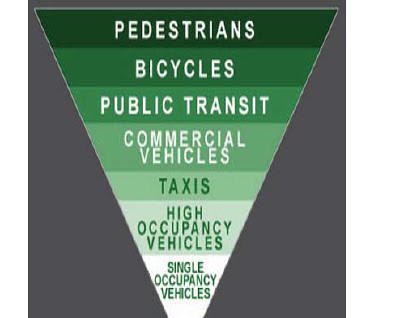
The Sustainable Transportation Hierarchy

image
Most communities, including DC, don’t prioritize transportation in this manner.

Not having an equivalent policy in DC always worries me when City Council legislates various aspects of transportation policy in bits and pieces, from proposing free parking for funerals, angle parking to accommodate churches on Sundays, tax incentives for gas stations, streetcars, tolls on the 14th Street bridge, etc., there’s no overall plan, no overall vision, but worse, there’s no recognition of the need for an overall plan and vision.

Via Rebuilding Place in the Urban Space Sustainable transportation policy, City of Stonnington, Victoria State, Australia

Turning vehicles a major danger to cyclists: study

BY MICHELLE LALONDE, THE GAZETTE

A recent study by researchers at McGill University and Montreal’s Department of Public Health suggests vehicles making right turns at busy intersections pose a more significant danger to cyclists than other traffic manoeuvres. The study also shows that bus stops in proximity to intersections increase cyclist injury occurrence.
"There are a panoply of solutions to this problem, and they all involve reducing the speed of vehicles turning right and improving the chances that motorists, cyclists and pedestrians will see each other in intersections," said Patrick Morency, a co-author of the study, which is to be published in an issue of the peerreviewed journal Transportation Research Records.

The study recommends cities analyze various measures that can reduce the danger posed by motor vehicles making right turns at high speeds, including:
–Reduction of turning radii (or sharpening the turn) to force the vehicle to slow down, so that drivers, pedestrians and cyclists have more time to see each other;
–Use of an exclusive bicycle and pedestrian signal phase;
–Advanced green lights for cyclists;
–Advanced stop line for cyclists, so the cyclists move ahead of vehicle traffic and are more visible.

Continue reading “Turning vehicles a major danger to cyclists: study”

Take It To the Streets

By Aaron Naparstek
A new mode of transportation is muscling its way onto city streets. Politicians, editorial boards, cops and business groups consider it a nuisance and a threat. The public is angry and confused. Suddenly, this popular new urban transportation option is challenging New Yorkers’ longstanding traditions and ideas about what a street is for, who gets to use it and how. Used by a relatively small number of New Yorkers, this new mode of transport makes its presence felt in a big way. Local politicians insist that something needs to be done. Editorial boards vilify it. The cops are cracking down. War? Housing? Education? Poverty? Who cares! Some days, if the local press is any guide, it seems like the No. 1 issue on the civic agenda is this new form of transportation on New York City streets.
This is a story about the Great Bike Backlash of 2011, right? Nope. I’m talking about the Automobile Backlash of 1920.
The tabloid ravings, harsh police tactics and political posturing aimed against bikes and bike lanes may seem intense today. In a historic context, however, the Bike Backlash of 2011 is nothing compared to the battle that took place during the decade after World War I when organized “motordom” carved out its place on New York City streets. (Yes, that’s how the automobile interests actually referred to themselves: They were “motordom.”)
University of Virginia professor Peter Norton details the early history of the car and the city in his wonky but fascinating book, Fighting Traffic. He describes the “blood, grief and anger in the American city” and the “violent revolution in the streets” of New York and other U.S. cities as automobile owners bullied their way on to city streets, literally, leaving a trail of mangled children’s bodies in their wake.
In the 1920s, motor vehicle crashes killed more than 200,000 Americans, a staggering number considering how many fewer cars actually existed in those days. These days, 35,000-or-so Americans are killed in car wrecks annually. Most of the dead are drivers and passengers on highways and in rural places. In the 1920s, most of the dead were kids living in cities. In the first four years after the Armistice of World War I, more Americans were killed in car wrecks than had died in battle in France.

Continue reading “Take It To the Streets”

New research explores cost bikes/transit integration (Updated)

by Jonathan Maus

Researchers analyzed existing practices and oversaw focus groups in five communities; Boulder/Denver, Colorado; Chicago, Illinois; Ithaca, New York; Portland, Oregon; and Santa Clara County, California.

Specifically, they broke down bike/transit integration approaches to four methods:

(1) “Bike on transit” (transporting the owner’s bicycle aboard – inside or outside – the transit vehicle),
(2) “Bike to transit” (using and parking the owner’s bicycle at a transit access location),
(3) “Shared bike” (sharing a bicycle, which would be based at either the transit access or egress point),
and (4) “Two bikes” (using an owner’s two bicycles at the access and egress location).

In terms of cost-effectiveness, the study found that “bikes TO transit” ranked best overall while the favored method of focus group respondents was “bikes ON transit”.*

The preference to bring bikes along for the transit trip has to do primarily with concerns about security. “Minor adjustments in terms of security could address the current challenge of “Bike ON transit” capacity limitations,” wrote researchers, “and make the less cost effective strategies comparable to “Bike ON transit.””

Learn more about this issue and download the full report here.

Continue reading “New research explores cost bikes/transit integration (Updated)”

Research Bolsters Case for Cycle Tracks While AASHTO Updates Guide

from Streetsblog New York City by Adam Voiland
For decades, dueling camps of cycling advocates have feuded about how to best accommodate riders. Some have pushed for the construction of Dutch-style cycle tracks, arguing that separated lanes make bicycling safer and less intimidating, while others have insisted such infrastructure isolates riders and makes cycling more dangerous than simply remaining within the flow of traffic.
Though the debate has grown bitter at times, neither group has had much in the way of rigorous peer-reviewed research to argue their case through the years. However, in the last decade a small but energetic group of academics has started to publish regularly on the topic.
The latest salvo, published online in February and in the current edition of Injury Prevention, comes from Harvard University researcher Anne Lusk. Her study compares crash rates at six cycle tracks in Montreal to nearby streets that had no bicycle facilities, and bolsters the argument that cycle tracks are safer. Lusk found that relative risk of injury was 28 percent lower on cycle tracks compared to the on-street routes.
In addition, she found that about 2.5 times as many cyclists used the cycle tracks than the on-street routes. The finding agrees with the conclusions of a number of other recent studies that show protected bicycle lanes improve safety and help attract new riders.

Continue reading “Research Bolsters Case for Cycle Tracks While AASHTO Updates Guide”

Educating motorists during Distracted Driving Awareness Month

from Bikeleague.org Blog by Darren

In a video response to questions from Twitter, Facebook, and his blog, the Secretary of Transportation, Ray LaHood, reminds us that April is Distracted Driving Awareness Month.

The League has been working to raise awareness of the dangers of distracted driving and support state laws to outlaw it. See our Advocacy Advance report on Distracted Driving. While the League focuses every day on cyclist education, distracted driving campaigns are important because they put the onus on drivers to do the right thing in keeping themselves and all road users safe. In that spirit, this month we are sending a mailing to ask members to support our work to do even more to stand up for cyclists and make motorists accountable.

STOP texting

The Bicycle Friendly State program evaluates motorist education programs and allows us to share best practices, create model driving test questions, and provide solid information to DMVs and driving instructors. We will continue to work with the Department of Transportation as well as pedestrian and motorcyclist groups and participate in the Decade of Action on Road Safety, which is being launched during Bike Month — and, of course, we will continue to spread the word about Distracted Driving. This story from Minnesota shows that distracted driving is still a major problem for cyclists.

We are telling motorists that sharing the road is a two-way street.

My Signature

Darren Flusche
League Policy Analyst

Flusche joined the League in April 2009 and has a B.A. in history from Syracuse University and a Masters of Public Administration with a concentration in public policy analysis from New York University.

Continue reading “Educating motorists during Distracted Driving Awareness Month”