
Continue reading “The leading cause of death for kids caused by their parents”
Man builds full sized Lego bicycle

What? Me distracted? Nah, just driving.
Porsche’s new steering wheel:

Continue reading “What? Me distracted? Nah, just driving.”
Are Doorings Really an Accident?
By Bob Mionske
…
Police quickly absolved the driver of any blame, noting that the car was “legally parked,” and the cyclist was not wearing a helmet.
Oh. I see.
But what about Section 430 of the Highway Safety Code, which prohibits the driver from opening his car door “without ascertaining that he can perform this maneuver safely”? Why are Montreal Police commenting on the legality of the driver’s parking job, when the only relevant legal issue is whether the driver observed his duty to safely open his car door?
For that matter, why did Montreal Police point out the cyclist’s lack of a helmet? Are they suggesting that a helmet would have prevented the collision?
Well, probably not. But they are probably implying that a helmet would have prevented the cyclist’s injuries—and that is an implication that is not supported by any evidence in this collision.
…
It was because the dooring was “an accident.”
Get it? If the driver had intentionally attacked the cyclist with his car door, that might be a different matter. But this was no brutal assault. It was just an accident.
You still don’t get it? Neither do I.
No, actually, it’s the Montreal Police who don’t get it. There’s nothing in the Highway Safety Code requiring drivers to “intentionally” break the law before they can be charged with a violation. If you’re speeding, you can be charged with speeding, whether you knew you were speeding or not. If you fail to stop at a stop sign, you can be charged with failure to stop, whether you saw the sign or not.
And if you open your car door and hit a cyclist, it doesn’t matter whether you intended to hit the cyclist, or just accidentally did it. Either way, you broke the law.
…
So it appears that the driver will be cited now, and will be required to pay a fine. A $30 fine.
I guess that’s something. But the cyclist, who was initially reported to be dead, is still in critical condition, still fighting for his life. Somehow, $30 just doesn’t seem to reflect that fact. I know it’s an improvement over the “it was just an accident” shrug of the shoulders we originally had from the police, but is that the best we can do when somebody is killed, or nearly so? $30?
Shouldn’t $30 be the kind of fine you get when you almost door somebody? When you kill, or almost kill somebody through your own carelessness, shouldn’t the penalty reflect that fact?
The confusion here about “accidents” isn’t just within the ranks of law enforcement. The legislatures themselves shoulder most of the blame for this confusion, because ultimately, they are the ones sending the message to drivers that “accidents” will not be taken seriously, no matter how serious the injuries the careless driver inflicts.
…
…
Continue reading “Are Doorings Really an Accident?”
Fines for bad driving set to rise for first time in 11 years
Speeding motorists and those caught driving while using a mobile phone face increased fines in proposals contained in the Government’s new Strategic Frameworkd for Road Safety.
…
On current levels of offending it has been calculated that the increase in speeding fines alone would raise an extra £35m in revenue – fines for other motoring offences are also likely to rise. However the Government has said it also has to bear in mind when setting fixed penalty levels, the likelihood that setting them too high will increase levels of non-payment – although there is an argument that it is exactly those who fail to pay such fines who should be the focus of the Government’s new ‘targeted approach’ to enforcement and deterence when it comes to pursuing rogue drivers. As well as fines the Strategic Framework proposes increased use of educational programmes for erring drivers.
…
[B’ Spokes: Whoops, wrong country, we only raise fines for towing away illegally parked vehicles, silly me thinking fines related to road safety.]
Continue reading “Fines for bad driving set to rise for first time in 11 years”
Don’t Hold Your Breath for a White House Transportation Bill
For those of you following the Federal Transportation Bill. The upshot is that congressional members are getting sneak peek at sections of the president’s draft but still we are not close to a final draft to be passed by congress.
https://dc.streetsblog.org/2011/05/12/don%e2%80%99t-hold-your-breath-for-a-white-house-transportation-bill/
New Reports: Higher Gas Prices Mean Safer Roads
from INFRASTRUCTURIST by Eric Jaffe
…
Social scientists, meanwhile, continue to explore the potential benefits of higher gas prices. A new report from Canadian researchers connects higher fuel costs with reduced sprawl. A pair of recent studies from Mississippi State (via The Transportationist) link higher gas prices with safer roads.
The first, which appeared in the Journal of Safety Research (pdf) last December, studied the relationship between gas prices and car accidents in Mississippi between 2004 and 2008. The researchers report both both short- and intermediate-term links between high prices and reduced crashes, with intermediate effects generally stronger. From a policy standpoint, the researchers conclude:
that if decision makers wish to reduce traffic crash rates, increased gasoline taxes are a considerable option because raised gasoline prices reduce traffic crashes directly.
…
Continue reading “New Reports: Higher Gas Prices Mean Safer Roads”
Come ride with Sophie [video]
The Ineluctable Politics of Transport Funding
Another springboard, this time from The Transport Politic
They have this quote:
» If we insist on charging car users to fund transit, we have to accept increasing highway spending in exchange for more public transport subsidies.
Which would more accurately put:
If we insist on not charging motorists for police, emergency services, long term road maintenance, (and they do not even pay a 100% of the new roads or general maintenance of the roads they use,) they will continue to need far greater subsidies then what has been “taken” by transit and other “non-motorized” uses.
Transit users pay into the system basically the same way auto users pay into the system, that it is to say what is paid in as “user fees” does not pay for everything that is used. It’s time to call a halt to this scam, as much as we would like to support more cars no one can afford it it. That’s is what is meant by not sustainable.
We are at a point if we gave all the money by motoring to motoring and all the current subsidies to mass transit and alternate uses it would be a huge boon to mass transit and other alternate modes of transportation and a huge loss to motoring.
Taxes for motoring have not kept up with the need and I don’t want to hear motoring is expensive enough without new taxes as that is precisely the point that has been proven… Support for motoring is really, really expensive and individuals don’t want to pay for it and we do not want to pay for it as a society.
The solution is defining our problems
I am using Cap’n Transit as a springboard with this chart:
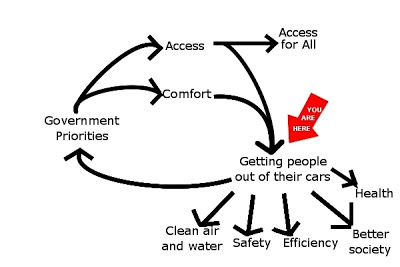
The faster cars can drive the more things that are convenient to get to and all those pesty little things in the lower right corner of the chart can be damed.
This kind of thinking has gone to such extremes like in Fells Point where minimizing delays only for motorists at minor intersections with no thought of improving throughput of the street as a whole (think synchronizing lights)
We need better and diverse solutions for all problems shown. Access and comfort are for all people and not just cars. Access and comfort is not a game to be won by shear MPH alone.