
Even though this story takes place in DC, it is worth noting the courage and conviction of this one cyclist who also happens to be a police officer. A truly eye opening experience in the ordeal to prosecute someone. And a bit of a inspiration:
"…This isn’t quite as good because you’ll notice none of the vehicular assault charges were pressed. They were dropped. I think its just as important to show that you can’t use your motor vehicle to bully cyclists on the road."
If you are in DC you can help but a point I would like to bring into Maryland "[cycling advocacy organization] agreed to give a community impact statement." I’m not trying to avoid giving WABA credit here just pointing out one of many services a bicycle advocacy organization provides and if your are not in WABA’s territory there are other groups willing to help. The worst thing any cyclists can do when involved in an accident is feel like they are alone. We are a community, and odds are if you are ill treated others are as well. Together we can make a difference.
The full blog post https://girlonabicycle.blogspot.com/2011/06/victory-sort-of.html
Leapfrog Development (even more sprawling development)
Is a remote 30 minute drive to anything and everything a good idea? Is it even better for retirees who will not not be commuting every day? Streetsblog.net, Angie Schmitt reports Stop and Move author James Sinclair response:
https://streetsblog.net/2011/06/09/leapfrog-development-rears-its-ugly-head-outside-of-fresno/
The Motorized Menace
Socialist Government Subsidies of Cars Must End!
by Elly Blue

THAT GIANT sucking noise? That’s the great socialist burden. Our liberal ruling class keeps real Americans struggling under an unbearable tax burden: cars.
The truth is, my friends, cars are emptying our pocketbooks and putting us in the red. The regional and federal governments’ tab for road land values, environmental costs, subsidized parking, and mopping up after crashes adds up to 28 cents for every mile driven. That means the average Portland driver eats up $1,972 of the public bankroll every year. Despicable!
Drivers have never covered their own costs, tossing a mere pittance to the state and fed—$325 each per year in taxes that go to roads and so-called “user fees”—while 40 percent of national road funding comes from our general taxpayer coffers.
Not that this should surprise anyone. Henry Ford himself, the father of the automobile, was a National Socialist. And that wasn’t a euphemism. He hoped for his product to be nationalized. Ninety years later, his dream came true with the auto industry bailouts.
Ford’s big-government, lock-step funding of wasteful car programs is the ultimate betrayal of the American way of life. We are in danger of paving over the very family values that have created our exceptional society of bold men and strong, lusty women. These days, our children can’t bike to school. Our elders can’t cross the street. Instead, we have wider and wider roads, filled with more and more cars that pump our hard-earned money directly into foreigners’ bank accounts. As if that weren’t enough, these same cars are frequently—and I would not lie to you, my friends—driven by homosexuals.
And gas. Gas! A filthy substance. It’s over $4 a gallon now, but its true cost is closer to $9. So who is paying for the other half? Taxpayers, that’s who. When the government subsidizes every gallon of gas to the tune of $5, it’s all of us who pay in the end.
Cul-de-Sacs Are Killing Us: Public Safety Lessons From Suburbia
from Streetsblog New York City by Tanya Snyder
People choose suburban neighborhoods over urban ones for myriad reasons: because they can afford it, because the schools are good, because it’s a quiet street, or crimes rates are low, or everyone walks around with baby strollers and golden retrievers, or their family is nearby. But countless other consequences stream from their decision of where to live.
If people can’t or don’t walk or bike where they need to go, they’ve also bought themselves carbon emissions from excessive driving. Hours lost in traffic congestion. Growing waistlines from spending time behind a wheel instead of on two wheels, or two feet. Stress and relationship problems. And even worse: The suburb they chose “because it’s safe” ends up being far more dangerous than the city they fled.
William Lucy, a professor at the University of Virginia and former chair of the Charlottesville Planning Commission, says that people’s decision making about where to live has such sweeping ramifications that he’s concentrated his professional work on it. And it’s why he focuses on danger and death: specifically, the danger of leaving home.
At a daylong forum yesterday on intelligent cities at the National Building Museum, Lucy could barely wait to lay into cul-de-sacs, which he says were designed for safety but end up being more dangerous than through-streets.
“They turn what should be a 100-yard walk into a two-mile drive, and they put more people in cars for more reasons than they should,” Lucy said. And because they get lulled into a sense of security, he said, parents don’t teach their kids about street safety and the “difference between street and sidewalk and driveway and yard.”
But the greatest danger to a young child, he said, is being backed over by a motor vehicle – usually driven by their own parents in their own driveway. Indeed, “backovers” account for 34 percent of “non-traffic” vehicular fatalities among children under 15 years old. (“Frontovers” account for another 30 percent, meaning that 64 percent of “non-traffic” vehicular fatalities still involve children being run over, according to KidsAndCars.org.)
Because these incidents occur on private property, they’re not considered “traffic” accidents and data is not collected by national traffic safety organizations. Meanwhile, Lucy said, squeamishness over openly reporting on the tragedy of a parent killing his or her own child with a car leads newspapers to bury news of backovers – missing a “teachable moment.”
Back to the “danger of leaving home”: Lucy compares the rates of homicides by strangers and traffic fatalities. (He studies homicides by strangers because he focuses on the danger of leaving the home: 80 percent of homicides are committed by someone the victim knew.) When people choose “safe” neighborhoods, they are often trying to protect their children (and themselves) from crime. But he finds that the likelihood of dying in a traffic accident is 13 times greater than the likelihood of being killed by a stranger. The most dangerous places, therefore, are those thought to be the safest, Lucy said: the outer suburbs.
He also stressed that “more crashes” doesn’t mean “more danger.” In urban areas, where cars are going slower, there are more crashes — but lots of them are fender-benders that don’t result in injury. Indeed, Lucy said, you’ll find less danger where there are more crashes. But where cars are traveling at high speeds, crashes are far more serious – both for people in cars and people biking or walking along the road.
“Young parents are choosing a location based on schools, but unfortunately, there are not enough parents of young children who are sufficiently aware that young children grow up to be teenagers,” Lucy said. “Nothing is more dangerous than a teenager in a car on a two-lane road at midnight after having had a little too much to drink.”
Perceptions of safety can sabotage actual safety in other surprising ways. Lucy likes to say that it’s the fire department that plans a city. Fire departments argue for wide intersections with gradual corners, even onto tiny cul-de-sac streets, making pedestrian crossings longer and more dangerous. Or the fire department mandates so many expensive fire-code fixes as old buildings get retrofitted for new uses that the project becomes too expensive. And then the outcome is a vacant building, which is far less safe than an occupied one.
Continue reading “Cul-de-Sacs Are Killing Us: Public Safety Lessons From Suburbia”
Alabama bans wine depicting naked nymph flying with bicycle
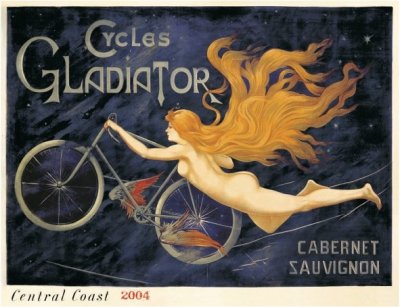
“The art is nothing new. The label is a replica of a Parisian bicycle poster dating back to 1895 and shows a nude woman flying through the heavens with a bicycle. Naked, yes. Pornographic, no.”
Continue reading “Alabama bans wine depicting naked nymph flying with bicycle”
Bikeability: What it’s Worth
Excerpt from Strong Towns Blog by Charles Marohn
…
One of the NextGen people I really admire (I admire them all, actually) is Eliza Harris (Twitter). She’s been very kind to me in sharing her time and enthusiasm to get me integrated into CNU. She’s also a fellow conservative-minded person and we’ve had some delightful conversations on the intersection of conservative thinking and New Urbanism. Very engaging.
Eliza moderated a session on bikeability – something outside of my core area of knowledge and competency, but something I need to know more about. I’m recording the session, but here are my notes.
Randy Neufeld, SRAM Cycling Fund, was the first speaker. He had some great photos and examples, but I’ll summarize his talk with a primary strategy that I really liked: Take people on a trip. We need to get our public officials out into communities to see how things like biking are done in successful places.
Jonathan Patz, MD, talked about some of the health benefits of cycling and reducing auto travel. Some interesting statistics and observations on “natural experiments” like Yom Kippur, where people reduced driving for religous reasons and there were large measurable benefits in asthma-related and other emergency room visits.
Maggie Grabow, states that 40% of all car trips are 2 miles or less, 50% of the population commutes five miles or less. How do we replace these car trips with bicycle trips? She did a model to see what would happen if one in five trips were replaced — not a radical amount. The result was that hundreds of deaths were prevented, hundreds of thousands of fewer hospital admissions and billions of dollars in savings. I really don’t question such radical results – just the activity alone would be a dramatic change from what most people get. And how easy is this?
Sara Rider, Saris Cycling Group, a company from here in Madison, discussed an incentive program that they put in place to encourage people to bike. Intersting approach and I can see the appeal to the culture of a bike equipment manufacturing company, but I have an incentive program that would be less complicated and more effective for the broader population – $5 gasoline. Here is a cool video that she shared:
A lot of these speakers promoted a group called Bikes Belong, so I’ll link to that website for you to check it out.
My colleague Jon Commers just sent me a Tweet asking about cold weather urbanism. I’m going to ask a question on cold weather biking, Jon, when we get to Q&A. Here’s the feedback from the group:
Many cold climate cities are big into cycling. As you go further north in Europe, cycling often increases. Also, we should not look at it as an either or – bike most of the year, but you might not be able to do all. Also, communities that get out and plow right away show a dedication to biking. Wear warm clothes and it is actually easier to do than skiing, snowshoeing or fishing.
Riding to work with DOT bicycle commuters a great way to start the week
from Welcome to the Fast Lane: The Official Blog of the U.S. Secretary of Transportation by Ray LaHood
This morning I biked to work with a group of DOT commuters from the Washington Monument to our headquarters building. The route was safe and well-marked; we enjoyed some exercise; and we didn’t burn a drop of gas–which saved us some money.
That’s what I call a successful commute.

Gathering on the grounds of the Washington Monument; photo courtesy Julie Fischer McCarter, DOT
President Obama understands that high gas prices are pinching family budgets across America. And at DOT we are committed to providing people with convenient, affordable, and healthy transportation options.
That can help ease the pain everyone feels at the pump these days. It can lower the burden of tailpipe emissions on our environment. And it can create economic opportunities. We know that building bicycle, transit, and rail facilities creates jobs. And we know that businesses will pop up where streets are friendly to bicyclists and pedestrians.

Enroute; photo courtesy Julie Fischer McCarter, DOT
Now, we can commute by bike here in Washington, DC, because this city has worked hard to make it easier and safer for people to use their bicycles–not just for recreation, but for transportation. Washington has become a bike-friendly city.
And if you don’t believe me, just ask the League of American Bicyclists, who recently recognized the city’s efforts with its Silver award. In fact, there’s an informal race on the East Coast to see which large city can be first to achieve the Gold award. When we have cities competing to be acknowledged for their livability, that tells me things are going in the right direction.
…
Continue reading “Riding to work with DOT bicycle commuters a great way to start the week”
Could Focusing on Repairs Please Everyone?
from Streetsblog.net by Angie Schmitt
I have been interviewing staffers on the House Transportation and Infrastructure Committee as part of a broader project for National Journal magazine profiling “Hill People.” To a person, Republican and Democratic staffers on the committee say they want to see a six-year surface-transportation reauthorization bill completed this year. Everyone knows that’s a tall order. It’s already June. There are few options to pay for the proposal because of Republican mandates on spending and taxes. The earmark ban further complicates the endeavor.
It is significant, however, that no one disagrees with the overall goal. With a green light from House leaders, staffers could soon find themselves happily horse-trading the bill’s details over pizza and Diet Coke. The only question is how they would narrow their focus, given the tight budget constraints. Smart Growth America may have provided one clue that could inch the committee down the yellow brick road. A report released last week found that between 2004 and 2008, states spent 43 percent of total road construction and preservation funds on the repair of existing roads, while the remaining 57 percent of funds went to new construction.
It’s more cost effective to focus on the repairs, even though they may not win mayoral or city council elections. The American Association of State Highway and Transportation Officials estimates that every $1 spent to keep a road in good condition avoids $6 to $14 needed later to rebuild the same road once it has deteriorated significantly.
Is there a grand bargain to be struck here? Could a focus–mandated from Congress–on repair and maintenance, instead of new construction, reduce the cost of a surface-transportation bill such that the legislating process could begin in earnest? Would Republicans and Democrats embrace that idea equally? What are the drawbacks? Why does maintenance get ignored by states and cities? What is the appropriate role for new construction in a tight budget situation?
Continue reading “Could Focusing on Repairs Please Everyone?”
Three Cycling Tips That Could Save Your Tailfeathers!
From BikeFlock.com
The media often reports bike crashes without any context about what actually happened. Unfortunately, this only serves to scare bicyclists and make the public think bicycling on the road is dangerous. The truth is, bicycling is safe. Most crashes—even those entirely the fault of the motorist—are avoidable by cyclists who know a few simple things about their environment.
The Basics
First of all, being visible and predictable are essential in all conditions. When riding in mixed traffic, it is especially important to be assertive in controlling your space and to communicate your intentions clearly. Following those basic guidelines will eliminate 95% of crash risk. It also results in more civility and respect from your fellow road users.
Special Dangers
There are 3 common themes that repeat over and over in reports of serious crashes. They are circumstances where the cyclist was unaware of specific dangers that are well known to those of us who study crashes. The first two, in particular, are especially heart-breaking because I’ve seen so many cases where they happen to vibrant young people who simply were never given simple information that would have saved their lives. After you read this article, you will have the information to keep these crashes from happening to you.
1) Dooring
Cyclists in large cities become aware of this one sooner or later. “Dooring” is what happens when a motorist or passenger opens a car door into the path of a bicyclist. A dooring can be relatively minor—resulting in nothing more than scrapes, bruises and rattled nerves—or it can result in death. While a cyclist can be killed by the door-strike itself, fatalities are more commonly caused by the cyclist being thrown into the road and run over. When the door is swung open, the cyclist swerves. The handlebars clip the door, yanking them to the right. The cyclist is then ejected into the lane of traffic.
 Dooring is the legal fault of the person who opens the door. But you have a vested interest in preventing this from happening to you.
Dooring is VERY easy for a cyclist to prevent! See Door Zone Video!
- Keep your entire body, and the ends of your handlebars, at least 5 feet from the side of a parked car. We refer to the area within 5 feet of parked cars as the “door zone.”
- The largest doors extend about 4 feet. You need to keep enough buffer that a suddenly-opened door won’t startle you into swerving in front of passing traffic.
- Watch where people drive their cars. People instinctively don’t drive their cars in the door zone when the lane is wide enough to avoid it. Next time you are on a road with parallel parking, notice where the oil stain and tire tracks are. The right tire track will always be as far from the parked cars as the lane-width allows. Unless the lane is very narrow, riding in the right tire track should keep you outside the door zone.
- Bike lanes: Most bike lanes are 5ft wide. So if a bike lane is next to parked cars, it will give you a good guideline of where NOT to ride.
- Sharrows (Shared Lane Markings): These are being used where there is not enough width to stripe a door zone bike lane. Don’t trust the placement to indicate where you should ride. The guidelines for sharrow placement is too close to parked cars and many municipalities are violating even those meager standards.
2) Trucks and Buses
The crash type known as a “right hook” is another common urban crash. There are 2 basic types of right hook crashes. One happens when an oblivious driver overtakes a cyclist and immediately turns right. This is best prevented by riding far enough into the lane to make drivers change lanes to pass, the ones who want to turn right will be more likely to wait until you pass the intersection. The other type of right hook happens when a cyclist is passing slower traffic and rides into the blind spot of a turning vehicle. The most deadly of these involve large vehicles.
 It’s essential that you understand the characteristics of large vehicles and the limitations of their drivers!
- A large vehicle must make a wide turn. As a result, it may be on the far left side of the lane and appear to be going straight. The vehicle will also off-track, so while the front turns wide, the back wheels will track close to the curb at the corner.
- If you ride into the space left for off-tracking, you will be knocked over before you know what’s happening, and you cannot escape the rear wheels.
- Trucks have large blind spots along their right side and in front of the high cab. These are areas the driver physically cannot see.
- A truck driver has a lot of responsibility when making a turn in a complex urban environment. He must watch for pedestrians crossing the road he is turning onto. He must also ensure his rig does not off-track over the curb and hit a pedestrian. When turning into a narrow lane, he will often have to drive the front of his rig into oncoming side of the road, thus, he needs to look ahead for conflicting traffic. The last thing a truck driver should be focused on is traffic sneaking up on his right side blind spot.
- God gave us eyes in the front of our heads. Coincidentally, our traffic system operates best by placing the legal responsibility on avoiding what’s in front of us. Don’t make the drivers in front of you responsible for you.
- Don’t pass trucks! Don’t stop between a truck and the curb at an intersection. If a truck passes you, slow down and let it get well ahead of you. Be aware that a truck driver might turn right from the left lane, this happens frequently on roads with very narrow lanes.
- For more tips and videos see What Cyclists Need to Know About Trucks
- Bike lanes: Never let paint think for you. Paint is static. Traffic is dynamic. An open bike lane may invite you to pass a queue of vehicles, but the decision to do that must be made based on ALL the existing conditions.
3) The Screened Left Cross
 The “left cross” is another common crash type. It happens to both bicyclists and motorcyclists. This can also be divided into 2 basic circumstances. The first happens when a driver simply does not see a cyclist or motorcyclist who is plainly visible. The best way to prevent this is to ride prominently, seek some indication that the driver sees you and keep your pedals moving while covering the brakes with a plan for evasive action in case they violate your right-of-way. The second type—the screened left cross—is very common in urban riding. It’s something many cyclists (and motorists) are not aware of. It happens when a vehicle is screened by a same-direction vehicle to its left. A motorist turns left in front of or behind the vehicle he sees and hits the one he doesn’t see.
You can prevent this by staying alert to your environment and recognizing where and how this dynamic develops.
- If you are approaching a queue of traffic, move to the left side of the lane and align yourself so you can see down the left side of the cars in front of you. This way, you can see vehicles waiting to turn left and those drivers can see you.
- If you are passing a queue of traffic on the right, move slowly. Recognize that every single gap in that queue that is aligned with a driveway or intersection is an opportunity for a driver to turn left across your path without seeing you.
- Be mindful that even when you are controlling a lane on a multi-lane road, traffic passing to your left can screen you from left-turning drivers. The closer the speed differential, the longer you will be hidden, making the lane appear empty. Drivers are typically more cautious about crossing full traffic lanes than bike lanes, but it’s important to be aware of the left-cross potential on any road.
- Also, be aware that if the sun is at your back, it is in the eyes of left-turning drivers.
- See Animation: Preventing the Left Cross for more detailed information.
- Bike Lanes: An urban bike lane encourages (and, in some states, requires) bicyclists to be in the exact position that makes them most vulnerable to a screened left cross (and numerous other crashes). Never be lulled into a false sense of security. Your risk of being hit is greater when you are beside the flow of traffic because you are in the cross-flow of traffic entering and leaving the road.
You can learn more about common crash types on this Florida Bicycle Association page.
There’s more to successful, low-stress cycling than knowing how not to get hit, but the tips and techniques above are essential, simple knowledge that could make the difference between an uneventful ride home and never getting there. If you’d like to learn more about safe and easy traffic cycling, visit CyclingSavvy.org.
Continue reading “Three Cycling Tips That Could Save Your Tailfeathers!”
How to Handle Bike-Car Accidents, Part 1
Excellent article from Road Rights by Matt Allyn https://bicycling.com/blogs/roadrights/2011/06/02/how-to-handle-bike-car-accidents-part-1/