Mobility efficiency

Excerpts from Rebuilding Place in the Urban Space by Richard Layman

Optimal
Definition: Best, by whatever criterion decisions are being made; thus yielding the highest level of utility, profit, economic welfare, or whatever objective is being pursued.


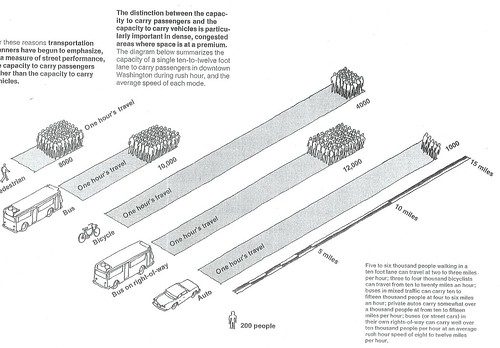
Mobility efficiency of various modes, one hour’s travel. (From the 1977 study, Central Washington Transportation and Civic Design Study.)
Mobility efficiency -- Passonneau

Any basic analysis of mobility can’t help but come to the conclusion that automobiles aren’t very efficient collectively in terms of moving large numbers of people, especially during short periods of time such as during rush periods.

Sprawl promoting economists choose to ignore key economic principles when it suits them

Major L.A. study shows importance of bike-transit connection

Excepts from Bike Portland:
* Bicycle-rail trips would replace approximately 322,000 motor vehicle trips and reduce 3.96 million vehicle miles traveled each year, offsetting approximately 2,152 metric tons of carbon dioxide equivalents (CO2e) annually. This would be equivalent to taking 422 motor vehicles off the road.
* Survey respondents overwhelmingly said that being allowed to take their bike on the train influenced their decision to travel by bike and rail. Of the 477 people who responded to the question, 65 percent chose “allowed to take bike on train” as a factor that influenced their decision.
* Respondents with access to a motor vehicle are more likely than those without access to a motor vehicle to cite “allowed to take bike on train,” “no car parking at station,” “bike lockers at station,” and “have to pay for car parking at station” as factors that influenced their decision to bicycle.
Continue reading “Major L.A. study shows importance of bike-transit connection”

End of the Easy Road

[Excerpt] By Brian Friel – Roll Call
The federal fiscal crisis started to affect transportation programs three years ago, when the economy tanked and dedicated gas and vehicle tax revenue fell off. In 2008, Congress began infusing the Highway Trust Fund with general funds from the Treasury. Lawmakers have propped up the transportation programs with $35 billion in such infusions since then and will have to do so again this fall — or agree to begin making cuts.
Continue reading “End of the Easy Road”

How to Plan Good Cities for Bicycling

B’ Spokes: I liked this article but it seemed to overly stress Copenhagenizing cities. Don’t get me wrong, nothing wrong with that as a end result but how do we get from no bicycle accommodations to being Copenhagen, what are the steps? As an example lets switch to an easier to understand accommodating the personal automobile when no accommodation for them exists, let’s say there are dirt "roads everywhere and that’s it. So what’s the first thing that should be stressed, one really expensive regional multi-lane expressway (and keep all local roads dirt) or just paving some dirt roads to create a regional network of roads so people can get around without using that many dirt roads?
So what I am trying to point out is the State’s over stress on trails (like only building a regional expressway with no viable way to get around off that expressway) and what Nate is doing in Baltimore City with wayfaring signs (so cyclists can get around without using car centric roads.) For many this is not as cool as trails or cycletracks but in my opinion this is exactly the correct first steps we need to grow into accommodating more cyclists. Now if we can only get the State to start thinking that way and start working closer with the counties to make a viable cycling network.
Main points in the article:
A Whole Hearted Bicycle Policy
Bicycles as Part of Integrated Transport Thinking
A Comfortable Network
Bicycle Cities and City Bicycles (bike rental/sharing)
On the Way to a New Bicycle Culture (bicycling is just a way to get around vs just for a small group of death-defying bicycle enthusiasts)

Continue reading “How to Plan Good Cities for Bicycling”

How to Handle Bike-Car Accidents, Part 2

[B’ Spokes: Just a excerpt, there’s more via the link at the end.]


I Was In A Collision—What Should I Do?

By Bob Mionske

You’ve just been hit by a car, and you’re lying on the roadway. In Part 1 of this article, I advised you to begin documenting what happened. But what if you’re injured and unable to function? Here’s what you need to know:

•    A good forensic engineer can reconstruct the accident.
•    Police reports and investigations are not the last word or even the best word on what happened.
•    If you think that the police got it wrong, you can make an effort to get the accident report amended, and through your attorney, have your own forensic engineer reconstruct the accident.
•    If you have a GPS device or GPS on your cell phone, it will track your ride, and the data can be retrieved later to assist in accident reconstruction.


Continue reading “How to Handle Bike-Car Accidents, Part 2”

Re-calibrating green building certification in two cartoons

from Switchboard, from NRDC › Kaid Benfield’s Blog by Kaid Benfield

Kaid Benfield, Director, Sustainable Communities & Smart Growth, Washington, DC

By now, we all know that an otherwise “green” building in a relatively inaccessible location is just a pretender, given that it will generate far more in carbon emissions than the building’s technology purports to save.  Conversely, even an ordinary building in a highly accessible, urban location is better for the environment than most anything that goes up in a greenfield.  It’s best to have both, of course: great technology in a great location.

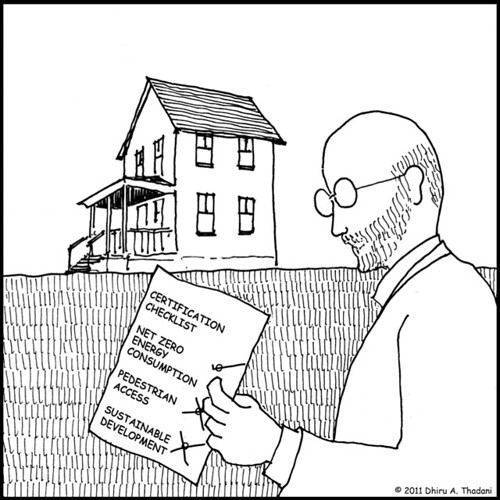
Alas, our current green building rating systems like LEED don’t work that way, even if they are inching in that direction.  So my friend, the multi-talented architect and visual artist Dhiru Thadani, has a suggestion or two.  Enjoy:
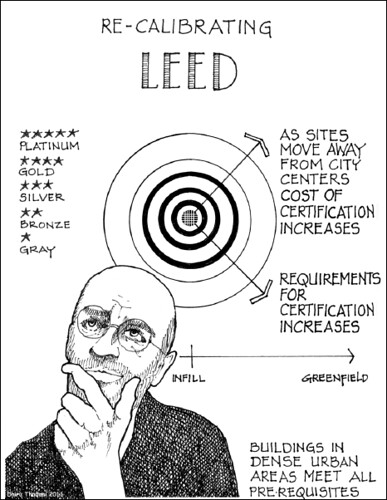
               re-calibrating LEED (by and courtesy of Dhiru Thadani) 

  certification checklist (by and courtesy of Dhiru Thadani)

Move your cursor over the images for credit information.

Kaid Benfield writes (almost) daily about community, development, and the environment.  For more posts, see his blog’s home page

Continue reading “Re-calibrating green building certification in two cartoons”

But accommodating cyclists would damage the enviroment

There is the argument floating around here that adding extra road width for cyclists would “damage” the environment by increasing impervious surface. Which to me is like being next to a coal burning power plant and then pointing to the guy that just dropped a banana peal in the dirt as the “polluter.”

But just when you thought bicycling could not get any greener a Dutch company came up with the idea of combining storm water management and a cycle path. So not only does it make the impervious surface for cars more environmentally friendly cyclists get their extra road width.
image
Continue reading “But accommodating cyclists would damage the enviroment”

Sacramento Police Ready To Race Across America

SACRAMENTO, Calif. — The Sacramento Police Department Cycling Team has assembled the first law enforcement team ever to compete in the Race Across America. The race is a 3,000-mile bicycle race from Oceanside, Calif., to Maryland.

The SPD Team will also use the race to bring national attention to the nearly 19,000 law enforcement officers who have been killed while protecting the communities of the nation.
The eight-member SPD Team will raise awareness and money to donate to the National Law Enforcement Memorial, Washington, D.C.

Continue reading “Sacramento Police Ready To Race Across America”