
By Sara Kaplaniak
Pretend you are on a game show and given a choice between two doors. Door No. 1 leads into a room filled with a toxic cocktail of soot, nitrogen oxides, hydrocarbons, sulfur dioxide, carbon monoxide, benzene, acetaldehyde and other pollutants.
Door No. 2 leads into a room full of fresh, clean air.
Which room would you choose?
Believe it or not, we choose Door No. 1 every day by living in a society that is dependent on motor vehicles. While we can’t always see or smell them, we’re breathing in pollutants emitted by the combustion engines of cars, trucks, buses and other modes of transportation. As a result, many of us suffer from asthma and other breathing and cardiovascular problems – and even certain cancers.
Pollution from motor vehicles also does a number on the natural environment in the way of greenhouse gas emissions that many believe cause climate change. In fact, according to the Paris-based International Energy Agency, carbon emissions reached a record high last year – up 5 percent from the previous record in 2008 – indicating that the world is closer to a level of dangerous emissions not expected to be reached until 2020.
According to The Conservation Fund, this prediction plays out in the Chesapeake Bay where the sea is likely to rise between 1.3 feet to 5.2 feet by the end of the century. In response, the fund and a consortium of partners produced a state-of-the-art map and website aimed at visualizing climate change scenarios that might play out around the Bay in future years.
This deeper study aims to inform strategies to address rising water levels, increased precipitation, extreme weather and land subsidence (already recorded around the Chesapeake Bay) that left unabated, promise to diminish the region’s tidal marshes faster than they can migrate to higher ground. In the absence of this habitat – a natural water filter and shoreline buffer – waterfowl, blue crabs, fish and other species face a reality to which they may not be able to adapt.
With attention from elected officials, independent commissions, lawmakers, environmental groups, scientists and activists, climate change represents a daunting issue for average citizens looking for a way to make a difference. In reality, making a big difference can be as easy as switching from four wheels to two. Bicycle wheels, that is.
In addition to being pollution-free, bicycle riding offers health benefits that accompany exercise, including weight loss, stronger muscles and an increased sense of well-being. No fuel is needed; although adequate nutrition and hydration help muscles pedal faster. Riding a bicycle for even one errand a day can help reduce harmful emissions entering the atmosphere.
…
That’s because in places like Carlisle, Pa.; Arlington, Va.; and Silver Spring and Baltimore in Maryland, municipalities are reducing vehicle lanes to calm traffic and improve safety while making room for more active modes of transportation like bicycling or walking.
Road diets largely represent transportation initiatives aimed at creating safer, less congested roads. But they provide an added benefit for environmental and human health and a great alternative to most bicycle riders in the United States who have to share roads with 3,000-pound motor vehicles.
Giving bikes a designated space within municipalities – and even connecting paths between metropolitan areas – provides an incentive for many people to dig up their helmets and locks for a ride to the library, the coffee shop, school or even to work. Most importantly, choosing bicycles over cars – and supporting policies that follow suit – represents something everyone can do.
The reward? Fewer trips to the gas pump, a slimmer waistline and cleaner air, which means a guaranteed spot behind Door No. 2. See you there!
Sara Kaplaniak lives and writes in Pennsylvania, where she reduces, reuses and recycles along with her husband and two kids. Distributed by Bay Journal News Service.
Continue reading “What’s behind door No. 2?”
Study: Vancouver Merchants Badly Misjudge Effect of Protected Bike Lanes
from Streetsblog New York City by Noah Kazis
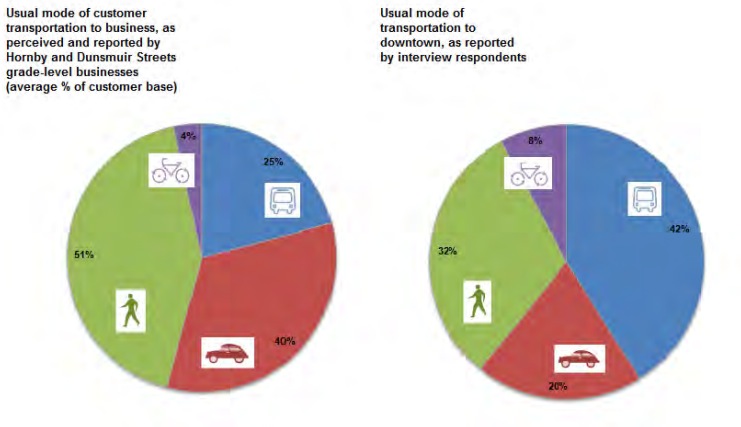
…
Continue reading “Study: Vancouver Merchants Badly Misjudge Effect of Protected Bike Lanes”
Heat cycles: how D.C. cyclists rode out the hottest July on record [VIDEO]
BY JAY MALLIN
“You’ve just got to embrace the sweat,” says one of the remarkably chipper cyclists in this short video on how to keep the heat wave from breaking your bike-commuting habit. He and the other cyclists interviewed actually look a lot happier and less sweaty than some of the people in the background. It’s enough to inspire you to trade four wheels and A.C. for two wheels and a breeze. After all, as one bike commuter who works for the Sierra Club says, “with climate change, we’re going to see a lot more Julys like this.” Maybe she and fellow cyclists are in good spirits because they know they’re not part of the problem.
Heat Cycles from Jay Mallin on Vimeo.
Continue reading “Heat cycles: how D.C. cyclists rode out the hottest July on record [VIDEO]”
Tax per mile driven
from TheWashCycle by washcycle
…
A true user fee for roads would charge a fee per mile driven
…
Anyway, to tie this in again, road lobbyists and supporters love to blame money spent on biking and transit as the cause for the shortfall in the Highway Trust Fund. But it’s clear, looking at this chart, that the cause is the reduction in the tax per mile driven that results from inflation and greater automobile efficiency and the unwillingness of Congress to raise the tax to adjust to that. If we had a tax of 11 cents per mile driven (as is the historical average) there would be plenty for roads. And we wouldn’t need to worry about higher CAFE standards reducing the trust fund.

What if Biking Being a Fun Thing *is* the Important Thing?
It amazes me the one thing you don’t want to say when advocating for more bicycling is “because it’s fun.” But why is that? Sustainable Cities And Transport makes some very interesting points which I’ll quote and add a few thoughts of my own.
But what if it’s entirely legitimate to want your cities to have enjoyable things in them?Gasp!
And if you think that Being a Fun Thing isn’t more important politically than Being an Important Thing, look at stadiums. There is nothing more settled in the policy research than stadiums. Cities always put more money in than they get out.
One unspoken item in opposing to bicycling seems to be “but commuting should be miserable or at least boring as heck..” Really, that’s the best you can do in supporting motoring centric infrastructure? Sadly the reality says yes, that is the ultimate achievable goal in urban transport… at least till you introduce bicycling and then all that changes.
But before bicycling can be a viable form of transport uber-fitness is required. At least that’s what the really out-of-shape crowd would like you to think, at least that is my impression as some of the most vocal anti-cycling are well, take this one for example:
 Robert ”I can’t support bike lanes” Ford
And of course there is the one line zinger guaranteed to put cyclists in a bad light … “the Lance Armstrong wannabes”… oh the burn, seriously? Granted social norms dictate to get your exercise in a gym and not on the public street and then if we were to stress “but it’s fun” that would by like saying it’s fun to go play in traffic, totally unacceptable by today’s mores. But shouldn’t fun+functional transport+fitness be more something of admiration and not of scorn?
One of the inspirational things of volunteering to help at a biking event is not seeing the uber-fit come in early but the Joe average come in last after 10 hours in the saddle and after riding 100 miles with a smile on their face. Now I have to pause here and ask who in their right mind would be motivated to spend 10 hours in a gym? Or driving a 100 miles just for fun, let alone paying good money to do so? Yet if you are a charity charging people to ride their bike 100 miles is a great way to raise money. Again, it is all because biking is fun and riding a 100 miles is within the ability of a healthy adult, sure you may have to work up to that level from where you are at but you don’t have to do crazy pro racer type training to get to this level.
100 miles by bike… think about it… now think how people think you can’t go as far on a bike as you can by car. OK I hear a few “but cars do go farther then bikes” out there which I will counter with think about driving from Baltimore to D.C. to see the Cherry Blossom Festive or to see the fireworks on the 4th of July, would you do it? Typical answer is “But the traffic and the parking is a nightmare, so no.” But with a bike there is no traffic nor parking problems, and that’s another point, the “ideals” of motoring do not fit the reality of too many people also doing motoring and we just cannot accommodate all those cars.
Biking to D.C. is one of my favorite things to do and I have seen the Cherry Blossom Festive and the fireworks on the 4th of July in D.C. all by bike and all very enjoyable. We have reached a point where people who bike do more and see more then people stuck with just the automobile as their only solution to travel. Why is this? Because biking is fun, going places is fun and life is just more enjoyable when it is fun. Life, Liberty and the pursuit of Happiness, that sums up cycling nicely.
But biking is still fun at the end of it all. It is indisputably fun. Bikers indisputably derive value from their biking. When was the last time you heard the argument go like this:You: “Biking is great, I really enjoy my commute.”
Opponent: “No, you’re wrong, you don’t enjoy it.”Never, that’s when. Your and others’ enjoyment is–after all of the noise–the core value that can not be discredited.
Continue reading “What if Biking Being a Fun Thing *is* the Important Thing?”
From Sprawling New Jersey, a New Way Forward for State DOTs
from Streetsblog New York City by Angie Schmitt
…
At the time, the Garden State was rapidly approaching the limits of its developable land. And the standard practice of tackling congestion with more roads just seemed to be a fiscal impossibility, says Jack Lettiere, who led NJDOT from 2002 to 2006.
“We spent tens of millions trying to relieve congestion,” said Lettiere. “The faster we went, the slower we went. People were getting mad at us. Funds were getting low.
…
At the time, NJDOT was building on a concept, pioneered by the state of Maryland, called “Context Sensitive Solutions.”
…
Believe it or not, this was a major departure from the standard practice at state DOTs. Even today, many state DOTs approach road projects as challenges in maximizing vehicle throughput.
“Most [transportation] departments will tell you that land use planning is not their purview,” said Lettiere. “I think that’s the problem that has to be overcome.”
…
“He said, ‘The real challenge is to get that practice accepted by people in the field.’”
“The highway guys are great about talking about highway thickness and adding five lanes to deal with congestion,” Biehler said. “But they’re not so great about talking to communities about land use.”
…
Continue reading “From Sprawling New Jersey, a New Way Forward for State DOTs”
Park Police hassle driver who stops at GW Parkway crossing
Crosswalks along the GW Parkway are very dangerous for pedestrians and cyclists. But instead of fixing the problem, the Park Police are pulling over and criticizing drivers who stop to let people cross.
https://greatergreaterwashington.org/post/11524/park-police-hassle-driver-who-stops-at-gw-parkway-crossing/
Bicycle Blue Lights: Student proposal, City Planning Innovations [video]
Update on Rumble Strips
From Alliance for Biking and Walking
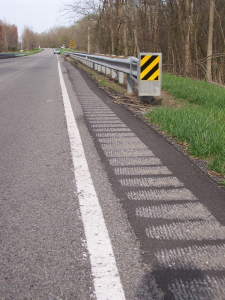
Since early 2010, the Alliance, League of American Bicyclists and Adventure Cycling Association have been working with the Federal Highway Administration regarding concerns about rumble strip applications.
In May 2011, the FHWA quietly distributed a new Technical Advisory (guidance) to district offices and state departments of transportation (DOT’s) on the installation of rumble strips. Unfortunately this guidance doesn’t meet the standards needed to ensure the safety of cyclists, and we did not get a chance to review it before its release as we had asked.
The new FHWA guidance on the installation of both shoulder and centerline rumble strips is significantly worse for bicyclists than the 2001 guidance. Not surprisingly, they did not notify us of the new guidance before sending it out to their district offices, even though we’d continually asked them to do so. When we learned about the new guidance in mid-June, we immediately contacted FHWA and set up a meeting.
Last month, the Alliance, League and Adventure Cycling returned to FHWA, where we met with a dozen FHWA and USDOT staff to express our concerns with the process and the lack of accommodation for bicycling in the new guidance. As a result of our meeting with FHWA, we are submitting written detail of the specific points the bicycling community wants to see addressed in the new guidance.
We made it clear that we are holding back on raising the alarm with bicyclists across the country, but we are asking for a complete revision of the Technical Advisory and will track this process very closely in the coming weeks. If we don’t succeed, we will let you all know and mobilize as needed. For now, please wait to take any action.
Why Should States Care About Bicycling and Walking?
from Bikeleague.org Blog by Darren
…
Since 1991, states have spent just over 1% of their transportation funds on bicycling and walking – even though these two modes now account for 12% of all trips and 14% of all fatalities in traffic crashes. These critical transportation modes connect people to jobs, friends and family, goods and services; they provide healthy, clean, efficient, and sustainable ways for kids to get to and from school; and they are increasingly popular and economically vital forms of recreation. Recent studies show that in addition to providing these benefits, investing in bicycling and walking infrastructure is very cost-effective and creates more jobs than traditional highway-only projects.
As our population continues to grow in rural and urban areas alike, providing real transportation choices – especially for short trips – is essential to reducing congestion, improving air quality, achieving energy independence, increasing physical activity levels, and improving traffic safety: critical goals that are squarely in the national interest, and goals that cannot be left to the whim of state Departments of Transportation who have proven unwilling to make these choices unaided.

Darren Flusche
League Policy Analyst
Continue reading “Why Should States Care About Bicycling and Walking?”