While there is a lot of detail in this free PDF: https://www.lulu.com/product/ebook/10-mistakes-that-can-derail-your-bike-injury-case/17392817
I still like WABA’s Bicycle Crashes FAQ better for a place to start and it’s simplicity: https://www.waba.org/resources/crash_faq.php
But certainly "10 mistakes that can derail your bike injury case" is a worthwhile read if you want to be prepared for a worst case scenario. But if you are not going to read it all then visit the WABA’s link.
No Criminal Assault Charges to be Brought Against Driver Caught on Camera Striking Cyclist
Despite video evidence and witness confirmation DC police are NOT bringing assault charges. Shame on DC police.
Read the story here: https://www.waba.org/blog/2011/09/no-criminal-assault-charges-to-be-brought-against-driver-caught-on-camera-striking-cyclist/
Live free or drive.
From the Washington Post:
Dear Dr. Gridlock:
A mutant species emerged last century: Homo automobilus accompanied by a reign of traffic. Particularly in the United States, we have evolved into human hybrids encased in tons of metal, glass and plastic. And, we have designed the landscape around that physique.
…
Sounds good — so you would think communities would want to promote more biking rather than expand roads and put up obstacles, like “Dismount before crossing” signs or having to press a button (often broken) to operate the traffic signal.
>>[B’ Spokes: Let me emphasize the often broken with no program for systematic repair. You have to call it in to get these things fixed (311 in the city and good luck finding the number for elsewhere). If there was a pedestrian crash does anyone look to see if the nearest ped button actually works? I doubt it but if there was a crash due to a malfunctioning light you bet they would fix that. But ped lights who cares if they work or not? Just deal with it seems to be the mantra of the areas with really high pedestrian fatality rates.]
…
Much of law enforcement is concerned with traffic. In the United States, according to 2009 statistics, an average of 93 people a day died on roadways. A car is a deadly weapon, and we have designed our lives around it.
Also, the car-oriented environment discourages walking and biking because of safety issues resulting in the growing problem of obesity.
It’s hard to imagine a world without cars, but oil is finite, so cars and other products based on oil are ultimately unsustainable. While we still have oil, we need to prepare for the post-oil world.
Live free or drive.
— Joan Grey, Arlington
Continue reading “Live free or drive.”
Share the Road. Save a Life

America’s roads are so bad you need a German car to drive on them
“Yes, let’s spend even more money on avoiding fixing the problems instead of actually fixing them.” – Our Failing Infrastructure by glynch
Fix bridges or accommodate bike/ped in the Federal Transportation bill?
The League of American Bicyclists makes this excellent point:
"Safety: Thirteen people died when the Minneapolis bridge collapsed in 2007: since then, close to 20,000 pedestrians and 2,800 cyclists have died on our nation’s highways, largely as a result of poor highway design and an historic lack of safe non-motorized infrastructure – exactly what the enhancement program was created to fix. No bridges have collapsed since 2007."
B’ Spokes: Of course the real issues is it’s not bike/ped spending that’s keeping bridges from being fixed, it’s over stressing capacity building that is returning less and less value on the dollar.
Continue reading “Fix bridges or accommodate bike/ped in the Federal Transportation bill?”
The important difference between a road and a street [video]
[B’ Spokes: Our roads are consuming more and more resources with less and less return on our investment. ]
Fact: Places With High Numbers of Cyclists Are Safer for Pedestrians
[B’ Spokes: Or read this why we support bicycling with Maryland’s high pedestrian fatality rate. It will help!]
by Ben Fried
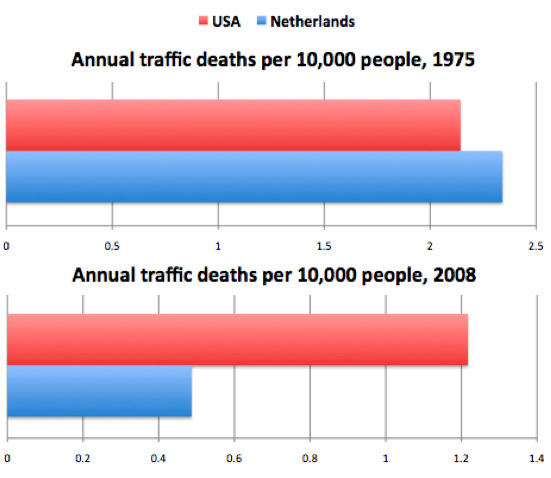
The United States has fallen far behind countries with high cycling rates, like the Netherlands, when it comes to overall street safety and preventing pedestrian deaths. Graphic: Streetsblog; Data: PPS
…
Well, how about Tokyo? A frenetic global metropolis with more than 13 million residents. With all those people rushing to get where they need to go, Tokyo still boasts a pedestrian fatality rate nearly half that of New York [which is lower then Baltimore]. And check this out: In Tokyo, 16 percent of all trips include cycling. That’s an order of magnitude higher than the current cycling rate in NYC.
…
The top cycling countries have also attracted international attention for achieving dramatic reductions in pedestrian fatalities. Sweden, with its Vision Zero initiative, cut pedestrian deaths in half in five years. Germany and the Netherlands are also leaving the United States behind when it comes to street safety. Between 1975 and 2001, American pedestrian deaths declined 27 percent while Dutch pedestrian deaths fell 73 percent and German pedestrian deaths fell 82 percent, according to a 2003 paper in the American Journal of Public Health by Rutgers professor John Pucher [PDF].
…
More car-free zones, pedestrian refuges, clearly marked crosswalks, and extensive, high-quality bike networks. Hmmm… Seen any changes like that around NYC recently? Imagine how much more progress we could make if our daily papers actually cared about street safety.
Continue reading “Fact: Places With High Numbers of Cyclists Are Safer for Pedestrians”
Disney Channel’s Chuggington characters offer valuable safety lessons
[B’ Spokes: Ah more propaganda on how to “how to crash safely.” Seriously, we need more information out there on how walk, bike and drive safely and end the acceptability of exceeding the speed limit by 10-15mph when kids, pedestrians and bicyclists are around. And that leads to the point I’m going to pull out of this post… cars kill. And if you think your kids are safer in the car then out on the street… well you might want to rethink that.
(Note the study that recommends child safety seats does not say what portion of the current childhood traffic deaths could be prevented. For all we know most childhood traffic deaths could have happened despite proper use of a child safety seat. Safe driving is far more effective then safe crashing.)]
Highlights from Welcome to the Fast Lane: The Official Blog of the U.S. Secretary of Transportation by Ray LaHood

The sad fact is that, according to the National Highway Traffic Safety Administration, crashes are the leading cause of death in children ages 3 to 14.
Continue reading “Disney Channel’s Chuggington characters offer valuable safety lessons”
Debunking the Cul-de-Sac
By EMILY BADGER
…
In their California study, Garrick and Marshall eventually realized the safest cities had an element in common: They were all incorporated before 1930. Something about the way they were designed made them safer. The key wasn’t necessarily that large numbers of bikers produced safer cities, but that the design elements of cities that encouraged people to bike in places like Davis were the same ones that were yielding fewer traffic fatalities.
These cities were built the old way: along those monotonous grids. In general, they didn’t have fewer accidents overall, but they had far fewer deadly ones. Marshall and Garrick figured that cars (and cars with bikes) must be colliding at lower speeds on these types of street networks. At first glance such tightly interconnected communities might appear more dangerous, with cars traveling from all directions and constantly intersecting with each other. But what if such patterns actually force people to drive slower and pay more attention?
“A lot of people feel that they want to live in a cul-de-sac, they feel like it’s a safer place to be,” Marshall says. “The reality is yes, you’re safer – if you never leave your cul-de-sac. But if you actually move around town like a normal person, your town as a whole is much more dangerous.”
…
Continue reading “Debunking the Cul-de-Sac”