
[B’ Spokes: This is a must watch video for any bike/ped advocate and planner. The following accompanies the video]
*********************************************************************************************
by Clarence Eckerson, Jr., Street Films
For more than 100 years New York City government policy has prioritized the needs of the automobile over the needs of any other mode of transport. Working under the faulty assumption that more car traffic would improve business, planners and engineers have systematically made our streets more dangerous and less livable. As a result, even the idea that a street could truly be a “place” – a shared space for human interaction and play – has been almost completely destroyed.
During his decade long effort to understand and improve the streets of New York City, entrepreneur and livable streets advocate Mark Gorton has gathered together a compelling set of examples of how transportation policy impacts the quality of our daily lives. Mark is regularly invited to speak in public about these issues.
In his current presentation “Rethinking the Automobile” Mark explores the history of autocentric planning and considers how New York and other cities can change. Filled with ample video footage of dozens of Streetfilms, we’ve worked with Mark to create a version of the presentation here.
As the founder of Streetfilms, Streetsblog, OpenPlans, and the New York City Streets Renaissance Campaign, Gorton has been on the front lines of the battle to transform New York’s streets. But Mark is not done fighting. He contends that the recent improvements that have been implemented in New York should only be considered as the “tip of the iceberg” and that a truly comprehensive set of changes are still necessary.
For more on Mark’s continued efforts to make our world more equitable, livable, and safe visit www.rethinktheauto.org
Continue reading “Rethinking the Automobile (with Mark Gorton)”
What Cyclists Need to Know about Trucks
By Keri, Commute Orlando
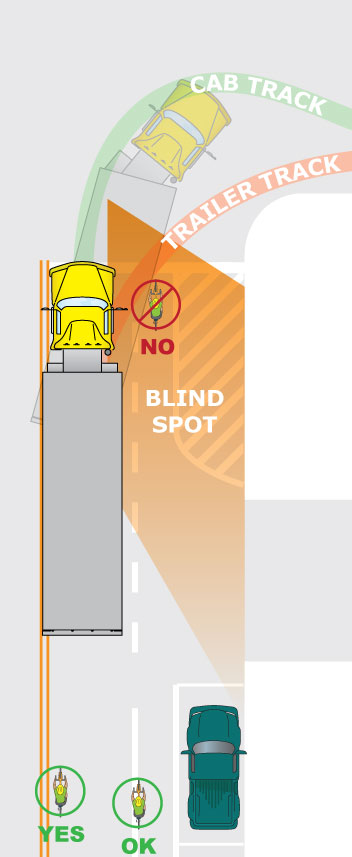
Trucks have huge blind spots. Truck drivers cannot see little things in their huge blind spots. Large vehicles off-track when turning, so they will appear to be going straight and often swing wide before making a right turn.
Cyclists hit by turning trucks is a repeating news story which highlights the most serious deficiency in our system — education of cyclists. Sometimes these crashes are caused by the truck driver passing a cyclist prior to turning right, but very often they are caused by the cyclist passing the truck on the right. In both cases, the cyclist has the power to avoid the crash.
Here’s how YOU can keep this from happening to you:
- Do not stop at an intersection on the right side of a truck. If you have already stopped in a bike lane and a big rig pulls up next to you, don’t assume the driver has seen you. Get off your bike and move it to safety (your life is worth the inconvenience). It’s better to stop in the middle of the general traffic lane if you arrive first. (In many cases it’s safer to stop in the line of traffic than to pass the queue.)
- Do not linger next to a truck on any side, in any lane. If you are riding near the same speed, slow until you are behind the truck. (This is taught to motorcyclists, it applies to all vehicle drivers, even car drivers!)
- If a truck passes you, slow down and let it get ahead of you ASAP. If you are approaching an intersection, merge to the left and ride near the center line to avoid the moving blind spot (see Left Cross in the Blind Spot).
- If you are in a bike lane and passing stopped traffic, do not pass a truck unless you can be clear of it before approaching any intersections or driveways and before traffic begins moving again. (This is a case where bike lanes offer a false sense of security that can get a cyclist killed.)
- Or, just don’t pass a truck on the right at all. And be cautious when passing on the left, too.
Trucks make wide turns. They cannot physically make a right turn from the right curb, so they will often leave a large, inviting opening on their right prior to a turn. They will also move straight into the intersection before starting to turn. When a truck turns right across your path, it is almost impossible to escape its rear wheels. So don’t get caught in a spot where this can happen! Be aware of what kind of situation can lead to a potential crash and avoid it.
Here’s an example of how blind-spot awareness saved my life last year.

A plan view of all blind spots (the rear no-zone is expanded for highway-speed following distance). From AAA Driving Survival.
I was riding North on Magnolia through downtown. I was in the bike lane. Approaching Concord, I saw a slow-moving truck in the right traffic lane. I slowed and hung back. We continued to Colonial, where the light was red. The bike lane is properly-striped to the left of the right-turn-only lane, so it would be correct for me to ride in it to the intersection. But the truck was in the right thru-lane and I don’t ride next to trucks. I decided to pull into the thru-lane behind it. Just as the truck reached the Colonial intersection, the light turned green. The truck driver turned on his right turn signal and turned right — across the bike lane and the right-turn-only lane. Yes, he made an illegal turn. He probably checked his mirror for cars in the turn lane, but he would not have seen me. He never did see me, I nonchalantly passed him on the left and went on my way. But it was not lost on me what would have happened had I made a different decision. And I wondered how many other cyclists would have made the same decision.
Acute awareness of vehicle blind spots was taught to me in motorcycle safety school. Perhaps if bicycle advocates and the bike industry put as much emphasis on education as the motorcycle industry does, I wouldn’t keep seeing articles like the following:
Here are 2 crashes from this month. Both of these cyclists were very fortunate to survive.
11/25/08 Elderly bicyclist injured in crash with big rig
[The cyclist] and the big rig were both stopped in the street waiting for a train to pass prior to the crash. Once the train passed, the big rig made a right turn from Lemon Avenue onto a side street, striking the still stationary bicyclist.
Note: the satellite view shows what appears to be a wide curb lane. Wide curb lanes allow cyclists to ride on the right of traffic, but cyclists should still be cautious about passing stopped traffic. If you suddenly find yourself in a situation where traffic is stopped and you are next to a big rig. Get off your bike and get off the road.
11/18/08 Cyclist Down: Fillmore and Fulton
The cyclist’s description: “I was cruising down Fulton eastbound and saw the truck ahead of me. I sped up a bit so I’d stay within range of his rearview mirrors. If I were too far back, the box part of the truck would block me. We approached the intersection and I was keeping an eye on his turn signal because I was passing the cars. I was going about 20 and there was no turn signal. As I came towards the intersection, I saw he was turning and hit the brakes. I skidded into the side of the truck and he kept turning, which pulled me under.”
Note: Fulton street has downhill bike lanes which are dangerous because cyclists can travel at motoring speeds. Any time you are traveling at downhill speed, you should be in the traffic lane. You need way more room to maneuver than a bike lane provides. If you are traveling faster than traffic, it is safer to pull into the traffic lane and slow to the speed of that traffic than to fly past it on the right. This allows you to easily pass right-turning vehicles on the left, instead of being hit by them as they cross your path.
Here are 4 more that have happened in the last 14 months. These cyclists were not so lucky. (All of these crashes involved cyclists in bike lanes.)
Cyclist, 22, Dies After Being Hit by Truck Near Dupont Circle
Cyclist killed in crash well known in Portland
Full cement truck drives over and kills cyclist ‘in an instant’
Bicyclist killed in dump truck crash identified
John Allen lists a bunch more in this article about mindless passing on the right (and how bad bike facilities encourage it while we educators are trying to discourage it).
When you know how to be safe around trucks, it won’t happen to you!
UPDATE:
Here is a video for cyclists by the Portland Water Bureau.
I also found this video from the trucking industry. This is aimed at motorists and highway driving, but it has some good blind spot images in it.
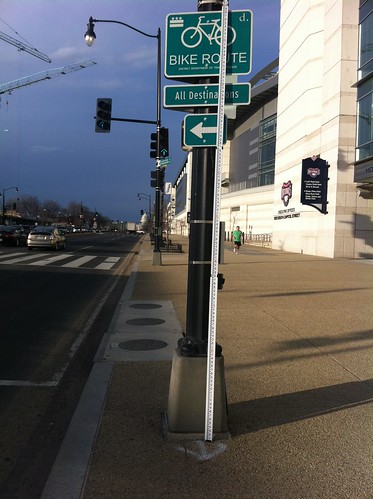
You can get to all destinations by bike
The sign says so:
via Washcycle
Continue reading “You can get to all destinations by bike”
Goodbye-ways: The downfall of urban freeways
By Greg Hanscom, Grist
…
“Cities are not removing all highways because of a sudden awakening of environmental consciousness or realization that car culture is bad,” the report says. Instead, they’re doing it because they can’t afford to keep aging freeways from crumbling, and they’re realizing that the space these roads take up is a hell of a lot more valuable, both socially and economically, when it’s used for houses, businesses, and parks. And then there’s the raft of studies showing that freeways don’t relieve traffic congestion — they actually make it worse.
…
https://grist.org/cities/goodbye-ways-the-downfall-of-urban-freeways/
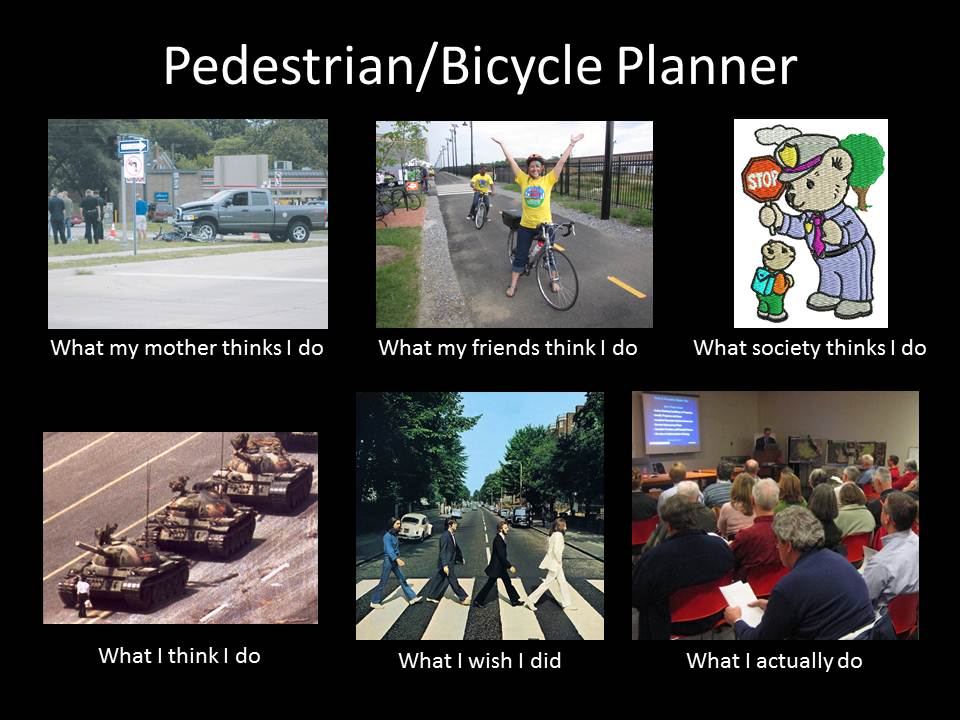
Pedestrian/Bicycle Planner
via our friends over at MoBike
Bike Lanes: The New Job Creators?
by Mark Plotz, from Pro Walk / Pro Bike® 2012 Newsletter Issue 5
Govern + Invest is a theme that will be explored at Pro Walk/Pro Bike® 2012: Pro Place. A question that will be examined is how bicycling and walking investments can add value to a community by creating economic activity, creating jobs, and improving quality of life.
Already we know that when it comes to jobs created per million dollars, bicycle facilities are one of the most efficient transportation investments. But once the paint dries and the asphalt cools, are there lasting economic effects? Can bicycle infrastructure build bicycle culture that will build a bicycle economy?
The answer seems to be yes-at least in the case of Long Beach. More than 20 new bicycle-related or bicycle-inspired businesses have opened at last count. I toured some of these business with Charlie Gandy and Melissa Balmer, during a recent trip to Long Beach, to meet these entrepreneurs, and prospect for locally-sourced goods and services for our conference. Twenty new businesses is a lot, especially in this economy, so you may be skeptical of these numbers (I
was); but after meeting some impressive young people, I can assure you that it’s all real.
was); but after meeting some impressive young people, I can assure you that it’s all real.
Pedestrian-Involved Collision Rates and Bicyclist and Pedestrian Demand at Multi-Lane Roundabouts
B’ Spokes: In this study "Identifying Factors that Determine Bicyclist and Pedestrian-Involved Collision Rates and Bicyclist and Pedestrian Demand at Multi-Lane Roundabouts" by UC Berkeley Safe Transportation Research & Education Center I’ll highlight this point:
"• European studies have shown that pedestrian and bicyclist crashes account for only 1 percent of the total crashes at roundabouts. By contrast, bicyclist and pedestrian crashes in the case study roundabouts accounted for a much larger percentage of total crashes (12 percent at Santa Barbara, 55 percent at East Lansing). This suggests that European roundabout design, bicycle and pedestrian facility design, or driving, walking and biking behavior may have a role in reducing the number of bike and pedestrian collisions."
So now I have to ask once again why is Baltimore doing one of these at Key Highway and Light Street? For pedestrian safety? (Ref: https://www.baltimorespokes.org/article.php?story=20120125151838526 )
The whole report: https://www.altaplanning.com/App_Content/files/pres_stud_docs/Multi-Lane-Roundabout-demand-collison.pdf
Complete Streets and Bicycle and Pedestrian Facilities Design Training through NHI
Across the country, states, cities, counties and local agencies are adopting policies that require pedestrian and bicycle facilities on roadways. Design knowledge is critical to implementing these policies, particularly in settings of constrained rights-of-way and budgets.
Sprinkle Consulting staff teach these courses to DOT and local agency staff around the nation. Please click on the link for more information. Bicycle and pedestrian facility design workshops.
Practicing engineering without a licence
[B’ Spokes: I feel this has some relevance to Baltimore as we have had non-engineers in a position of power demand that bike lanes be removed or not installed purely on the basses of faulty engineering methodology. So maybe I am practicing engineering by making that statement? That’s not the point of the following article, anyone has a right to make comments but the decisions should/must be left to the engineers. The fact that we have had no official engineering feed back at all just responses along the lines of “So and so doesn’t want a bike lane so no bike lane.” That to me is practicing engineering without a licence and illegal in Maryland. (§ 14-301) ]
THE LATEST ATTACK ON CYCLING ADVOCACY
By: Steve Magas, March 12, 2012
Jerry Walling and Roger Brislawn do what many, many cyclists around the country do – they sit on the Bicycle Advisory Committee of their community. They never dreamed that accepting this role, and reviewing bike crashes, would lead them to the brink of “large fines and imprisonment...”
These “BAC’s” are numerous in Ohio – and around the country. They are generally defined in some way by City Council in the city charter or other official documents. Folks who sit on these Advisory Committees are generally knowledgeable but not experts – certainly not engineers – and may be appointed because of their cycling experience and knowledge. These Committees typically look at problem areas, roads and intersections and make recommendations to the City to help make cycling safer in the community.
Jerry and Roger are both experienced Committee members. In Beavercreek, the “Bikeway Advisory Committee” was established by City Council in 2000 through the passage of a City Ordinance which described the purpose of the Committee: “To facilitate non-motorized travel within the City by advocating the proper planning and implementation of non-motorized improvements.” The Committee has a long history of working with City Council and is featured prominently on the City’s website.
From 2000-2011 the Bikeway Advisory Committee seemed to work well in Beavercreek – or so Jerry & Roger thought. That changed in August 2011 when Jerry & Roger received a little present in the mail – a certified mail letter from The Ohio State Board of Registration for Professional Engineers and Surveyors.
I’m certain they found this rather odd – signing for a registered letter from such a group. Neither of the men is an engineer or surveyor. Upon reading the letter, however, the shock… and fear.. set in.
The letter cited the men to Ohio Revised Code Section 4733.01 – the code section which defines the “practice of engineering.” The Board stated that it had received a “complaint” alleging that work the men had done for the Bikeway Advisory Committee “may fall into the realm of traffic engineering and could effect public welfare, safeguarding of life, health or property…”
The words that REALLY got Jerry & Roger’s attention, though, were these: ”Since you are not registered with the Board as a professional engineer, this could be a violation of Ohio Revised Code Sections 4733.02 and 4733.22. A violation of these codes could result in large fines and imprisonment.”
VW supports Ride on Washington bike ride with Tim Johnson
[B’ Spokes: Too often it feels like there is a war between cars and cyclists fighting over limited resources (road space) so it’s nice to see something like this. ]
********************************************************
By Adam Yamada-Hanff, Torque News
…
“This is a perfect way for Volkswagen to launch its support of Tim Johnson and the entire American cycling community,” said Jonathan Browning, President and CEO of Volkswagen Group America. “We see what Tim is doing, not just working to win races but also to help foster better cycling conditions in America. It mirrors how Volkswagen sees integrated transport developing in the future.”
Volkswagen also recently announced a partnership with Bikes Belong and USA Cycling, as well as several event sponsorships including support for the Sea Otter Classic in California.
…
Continue reading “VW supports Ride on Washington bike ride with Tim Johnson”