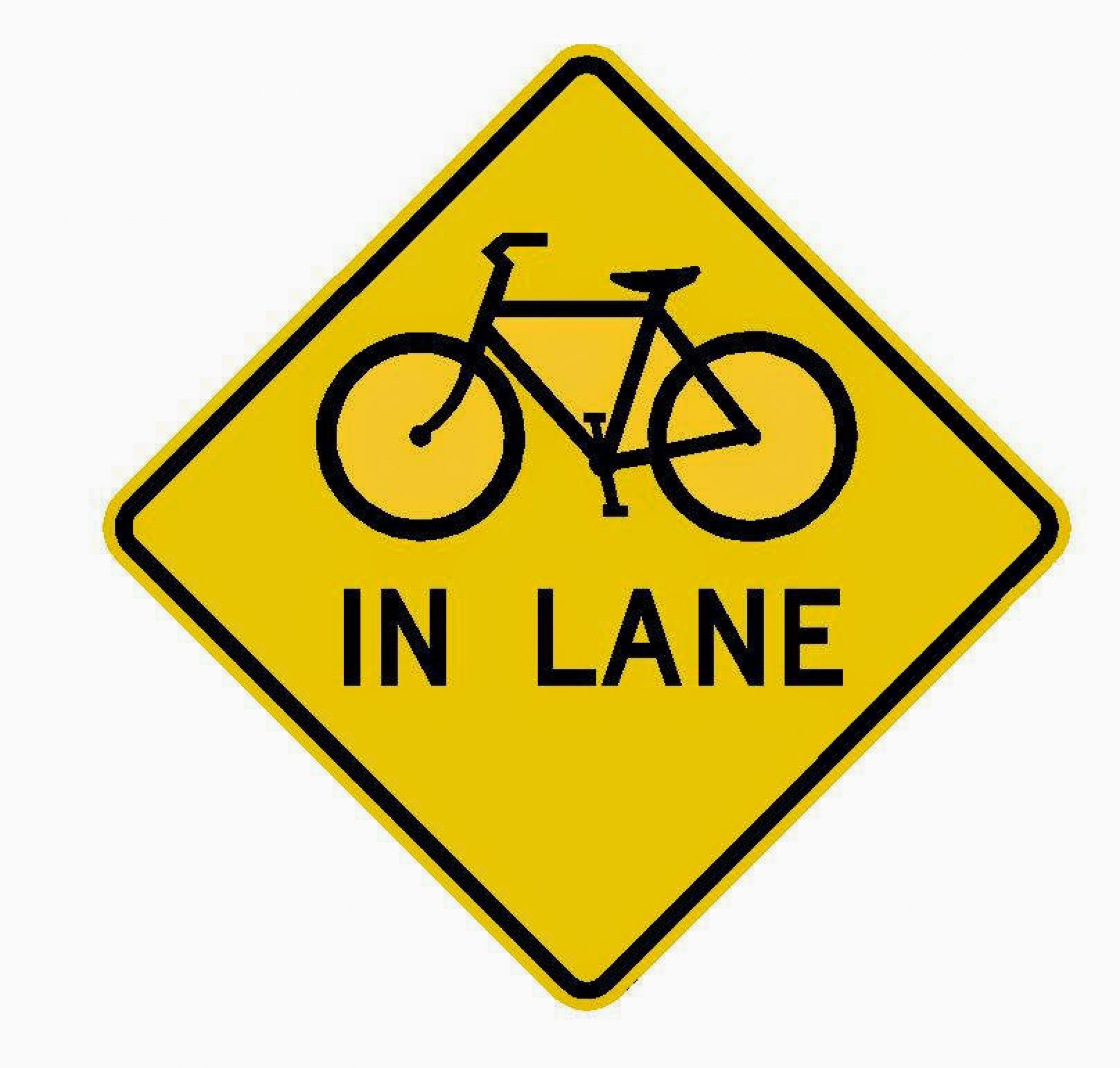
Like car drivers and passengers, cyclists deserve to be able to ride two abreast

[B’ Spokes: I touched on this topic previously: Father and son ride comfortably on Wabash buffered bike lane]


By: Peter Smith, googlemapsbikethere.org

Had that thought yet again (and it’s not a new argument) when I was trying to have a conversation with a friend this weekend in SF on my way to Sunday Streets. Every time I or my friend snuck up on the side of each other so we could actually have a discussion — or just point out something interesting — we got chased back into the bike lane by zooming motor vehicles. Being forced to single-file it everywhere can make biking a lonely experience — we deserve better.

Many of the harmful effects of loneliness are well-known, aside from the fact that being lonely just sucks. Depriving people of social contact is just one of the many ways we can effectively torture people. And we know that poor urban design can increase loneliness.

Being forced to ride single-file, and therefore being disallowed to communicate while we ride, is not torture, but it is a significant deterrent to biking when compared to driving and taking public motorized transit. If we care about putting more people on bikes, we need to advocate for the ability to ride two-abreast. And even if we don’t care about putting more people on bikes, we cyclists still deserve the right to ride two abreast, just like drivers and their passengers.

If I want to hang with a friend — all other things being equal — if I can’t talk to them while we’re moving about, I’m driving. That decision is simple. I want to be able to talk to my friends while we’re riding our bikes around. Cars do not deserve two to three times the asphalt just because they’re wider. If people are really dedicated to getting around by individual private motorized transport, they can go buy a Tango ‘single-file’ car:
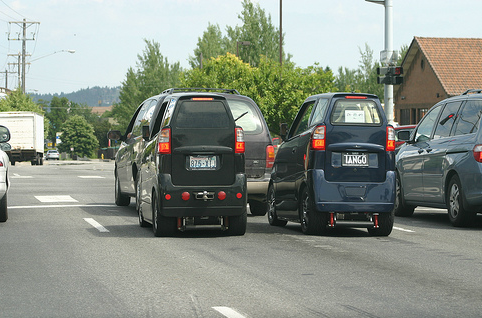
‘Single-file’ cars — not as space-wasteful

Drivers and their passengers don’t have to deal with this ‘single-file’ nonsense, why should we? And look where this single-file biking was being forced to happen – one side of the street even has two lanes for motor vehicles, so two sets of drivers/passengers can have a decent conversations with each other, while bikers are forced to ‘get in line’.
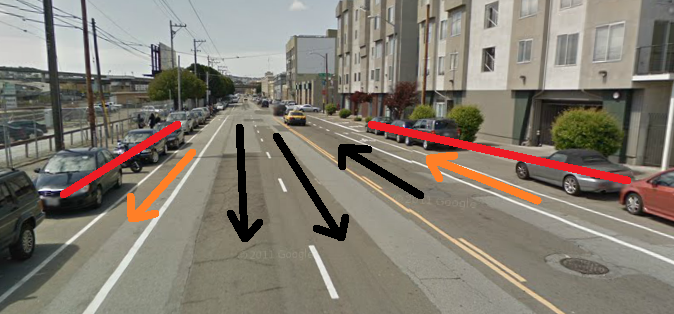
5 (fat) cars lanes, two (skinny) bike lanes

Shoot — even pedestrians on the sidewalk have to deal with this all the time – except most of the time it’s inanimate objects like traffic lights and parking signs and fire hydrants and trees and an assortment of other obstacles which force walkers to ‘single file it’ on the sidewalk time and again.
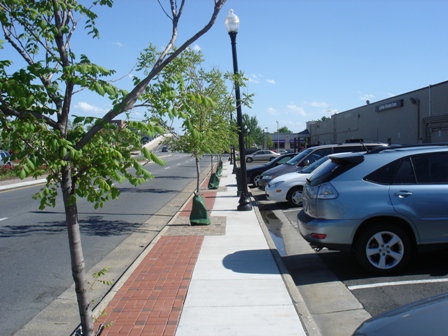
Pedestrian slalom course

The new Prospect Park West (PPW) street design in Brooklyn New York City is going to replace some unused, restricted road space — currently in line with a ‘parking row’ — with some pedestrian islands. The key benefit being touted is ‘increased pedestrian safety’. The islands probably will do that, if only slightly. If we were really concerned with pedestrian and biker safety, though, we’d two-way the street, and provide more room for people to bike.

Why would we want to allow cars to travel in the same direction, in separate travel lanes, while allowing bikers only single-file access?

And why would we want to continue to apportion the street 80/20 in favor of cars?

It doesn’t make any sense.

Maybe it’s not politically feasible at the moment to two-way PPW, but the proposal to fix this street fully and correctly should now be on the table, and that includes giving cyclists the ability to ride two-abreast. It goes without saying that walkers should be afforded this same luxury.

Here is the current PPW design:
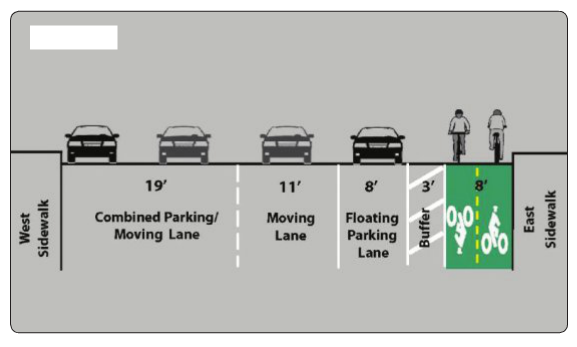
Cyclists not able to ride two-abreast

Here is the proposed design (not much different):
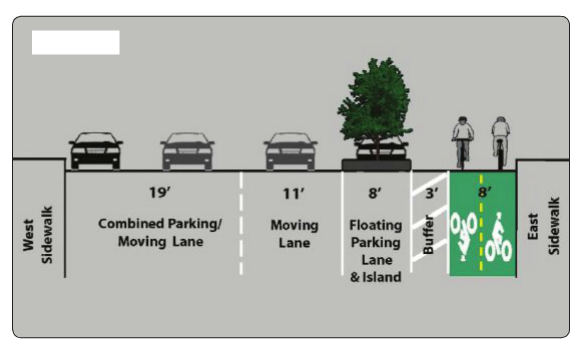
Nice trees, but bikers still cannot ride two abreast


This is closer to what it should look like — a two-way PPW:
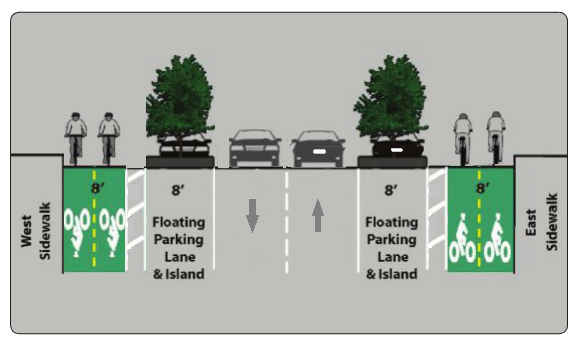
Now bikers can ride two abreast

And if we proceed apace we can imagine a time in the not-too-distant future when cars will no longer be tolerated. If any type of motorized mode of transport can be substantially shown to be in alignment with the goal of a Vision Zero policy, then we can consider allowing them to continue to be used among the population. That could be cars, trucks, trains, buses, NEVs, etc. The burden of proof of safety, of course, remains on those wanting to use these modes of transport.

Continue reading “Like car drivers and passengers, cyclists deserve to be able to ride two abreast”

Culture of Fear [video]

[B’ Spokes: While the topic of this video is not something I focus on in this blog but it does get into relative risk at the 45:00 mark, which is something I have touched on in the past. I would love to see agents of the US stationed at fast food drive through to prevent unnecessary deaths or how about TSA pat downs before we get into our cars? Anyway I would love to see something like this done to show how the real risk of cycling is not any where near the perceived risk that society thinks it is.]


Specialized Turbo electric bike launch [video]

[B’ Spokes: First, it’s a shame that this bike is illegal in the US but I think this is such a great idea, as we have hybrid gas/electric vehicles why not hybrid human power/electric vehicles? I love the concepts behind this bike, you still have to pedal and you can go fast with just moderate exertion. We need more transportation options especially ones that don’t burn gas.]


Best practice in accommodating bicyclists during construction

B’ Spokes: You may be familiar that our State Law requires “best practices” in accommodating cyclists in all phases of construction yet I have seen too many trails closed with no alternate route given, construction crews who close off bike lanes unnecessarily so to show off best practices that MDOT and local DOTs need to adopt (as required by state law) I found the following from San Francisco:


Section 9: Bicycle Routes

Appropriate measures shall be taken to ensure the safety of bicyclists on ALL streets on which there is construction. Contractors should pay special attention to streets that are on the Bicycle Route Network (Map 5 in appendix C). There are three kinds of bicycle routes on the network and the Contractor is required to maintain the construction area according to the following rules:

9.1 Bike Paths (Class I)

Construction on off-street bike paths shall provide an alternate route for bicyclists either by use of an alternate paved path or a temporary bike lane on the street. Any temporary bike lane on the street requires a STP.

9.2 Bike Lanes (Class II)

Contractor shall maintain all existing bike lanes. During construction, temporary bike lanes may be delineated by cones but at no time shall the clear width of a bike lane be less than 5 feet. Any bike lane that is effectively narrowed below 5 feet is considered a bike lane closure.

Bike lanes may be closed but only with an approved Special Traffic Permit or City Contract Specifications. An approved STP may require that additional bike signs such as “Bicyclists Allowed Use of Full Lane” or “Bicycle Route Detour” signs be posted as part of the conditions of the permit (see signs in Appendix D).

9.3 Bike Routes (Class III)

Certain streets on the bicycle route network may not have painted bicycle lanes but are nonetheless important because they provide connectivity to the rest of the network. In particular some bike routes allow bicycles to travel side-by-side with cars in the same lane. These streets are identified as having wide right-hand curb lanes. A curb lane is measured from the curb to the nearest lane line. Wide curb lanes are those that are 22 feet or more in width on streets with parking, or 14 feet or more on streets without parking. Contractor should maintain these widths wherever possible. If a wide curb lane will be affected during construction, the Contractor shall post a “Bicyclists Allowed Full Use of Lane” sign at the beginning of the block, and a “Bicycle Route Detour” sign with the legend “å BIKE LANE” at the point where the effective width of the curb lane drops below the aforementioned values (see signs in Appendix D).

9.4 Closure of Bike Routes

A Special Traffic Permit is required for any street closure or the closure of one direction of a street. The STP may require that a Bicycle Route Detour be provided and that additional bike signs such as “Bicyclists Allowed Use of Full Lane” or “Bicycle Route Detour” signs be posted as a permit condition (see signs in Appendix D).

Bicycle Signs
(Black and Reflective Orange)

Bike Route Logo Detour Bike Route Logo Detour LEFT Bike Route Logo Detour VERTICAL Bike Route Logo Detour RIGHT


Continue reading “Best practice in accommodating bicyclists during construction”

Institution of Mechanical Engineers calls for blind spot sensors to be made compulsory on HGVs and buses

[B’ Spokes: It amazes me that this is coming from the UK and not the US which is known for its “safety” requirements for motorized transport.Not to mention FARS reporting a higher percentage of bike/ped killed by the right side of trucks vs passenger car. (Links follow)]


by Simon_MacMichael, Road.cc

The Institution of Mechanical Engineers has called for all lorries and buses in the UK to be equipped by 2015 with technology to prevent cyclists from being killed or seriously injured as a result of their being in ‘blind spots’ alongside large vehicles. The appeal has been made in a report published today, Intelligent Transport Intelligent Society.


https://road.cc/content/news/56929-institution-mechanical-engineers-calls-blind-spot-sensors-be-made-compulsory-hgvs


Links to FARS:

Pedalcyclists Killed in Single Vehicle Crashes, by Vehicle Type and Initial Point of Impact – State : USA, Year : 2009

Pedestrians Killed in Single Vehicle Crashes, by Vehicle Type and Initial Point of Impact – State : USA, Year : 2009

Cars Designed to Intimidate Us

By Mike, Mans Greatest Mistake

“Perhaps another marker of corroded social relations and lack of trust among people was the rapid rise in the popularity of the Sport Utility Vehicle (SUV) …These are vehicles for the ‘urban jungle’, not the real thing.

Not only did the popularity of SUVs suggest a preoccupation with looking tough, it also reflected growing mistrust, and the need to feel safe from others. Josh Lauer, in his paper, ‘Driven to extremes’, asked why military ruggedness became prized above speed or sleekness, and what the rise of the SUV said about American society.He concluded that the trend reflected American attitudes towards crime and violence, an admiration for rugged individualism and the importance of shutting oneself off from contact with others – mistrust. These are not large vehicles born from a co-operative public-spiritedness and a desire to give lifts to hitch-hikers – hitch-hiking started to decline just as inequality started to rise in the 1970s. As one anthropologist has observed, people attempt to shield themselves from the threats of a harsh and untrusting society ‘by riding in SUVs, which look armoured, and by trying to appear as intimidating as possible to potential attackers’”

The Spirit Level: Why Equality is Better for Everyone
Richard Wilkinson and Kate Pickett

https://www.mansgreatestmistake.com/the-politics-of-cars/cars-designed-to-intimidate-us

“I was only speeding slightly”

As part of a long running campaign to make road users aware of their own influence on road safety the Dutch Ministry for infrastructure and the environment recently launched a new series of commercials. These ads run on national television.

It is very clear who is held responsible here. Drivers are directly addressed to reflect on their excuses for speeding.

There is no excuse for speeding when another person’s safety is at stake.

https://bicycledutch.wordpress.com/2012/04/13/i-was-only-speeding-slightly/

Cuyahoga Valley Scenic Railroad gives discounted fare to passengers who bicycle

[B’ Spokes: It would be nice to have something like this for the C&0 Canal.]
***********************************************************************************
By: Colin McDermott, newsnet5.com
PENINSULA, Ohio – People who like to bicycle along the paths in the Cuyahoga Valley National Park might enjoy the experience more.
The Cuyahoga Valley Scenic Railroad begins a new program Saturday called Bike Aboard! that charges cyclists a $2 fare for the railroad.
Here’s how it works: People who bike the Ohio and Erie Canal Towpath Trail in one direction can ride the rail in the other direction for $2.
Cyclists can also decide how far along the rail they want to go, stopping at any of the six stations in between Independence and Akron.
The service is offered weekends in April and May. Train tickets normally range from $10 to $25.
The park hopes this will lure more people to use the park, and see more of the National Park as they do it.

Continue reading “Cuyahoga Valley Scenic Railroad gives discounted fare to passengers who bicycle”