
Posted by Jonathan Mau, Bike Portland
"Survey results suggest that patrons who arrive by automobile do not necessarily convey greater monetary benefits to businesses than bicyclists, transit users, or pedestrians. This finding is contrary to what business owners often believe."
https://bikeportland.org/2012/07/06/study-shows-biking-customers-spend-more-74357
BEING ON FOOT DOESN’T MAKE YOU SPECIAL
B’ Spokes: Here are some excerpts from this great satire piece by By Matt Meltzer on Miami Beach 411 (pertains to Maryland as well I think):
Turning right on a red? As long as there’s no cars go for it. Doesn’t matter if a family of five is trying to cross. If they live in Miami, they know to stop. Crosswalk without a stop sign? That’s what we in Miami call a colossal waste of street paint. Nobody’s slowing down, and cars are a lot bigger and faster than you. Chance it if you like, because you think you have some sort of “right of way.” But the consequences if you’re wrong aren’t worth trying us.
LAWLESSNESS = EFFICIENCY
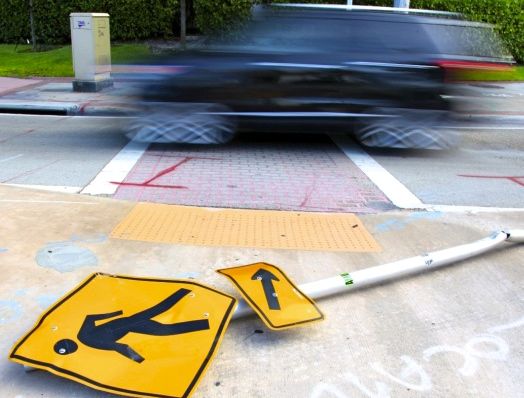
Now some would complain and say this makes Miami a dangerous city. I say it actually helps us be more efficient. Traffic here – especially street traffic – is bad enough as it is. And what with the new red light cameras curtailing our trademark “Four to a Red’ move, it’s getting even slower. Could you imagine if our drivers had to wait for slow-moving tourists to cross the street too? We’d never get anywhere.
Read the full article: https://www.miamibeach411.com/news/miami-pedestrians
What a Difference 60 Years Makes: Dragnet’s Hunt for a Hit-and-Run Killer
by Angie Schmitt, Streets Blog
We have to thank Network blog Copenhagenize for pointing us to this video, from a 1954 episode of the classic detective series Dragnet. In this installment, Los Angeles Police Detective Joe Friday and his team investigate a hit-and-run collision that killed a young boy and his grandmother as they were crossing the street.
Apparently the attitude toward traffic deaths among law enforcement officials has changed quite a bit since 1954, notes Copenhagenize’s Mikael Colville-Andersen:
As Sergeant Joe Friday puts it [6 minutes, 18 seconds in]: “How much difference, for example, as far as moral guilt is concerned, is there between the following: #1 the man who plans a killing, takes up a gun, finds his victim and shoots him to death. And #2 the man who thinks he has to look out for no one’s welfare but his own, gets behind the wheel of a car, disregards the ordinary rules of safety and proceeds to commit homicide with a motor vehicle. Often times the crime masquerades under the guise of an accident. Morally, no matter how you spell it, it adds up to murder just as surely as if the person had taken a gun and shot his victim down.”
Imagine. Look at how much air time was given to a hit & run. Things have certainly changed. Maybe lucrative car commercials ended up weeding out bad branding like this storyline.
Contrast that with modern-day New York City, where the family members of hit-and-run victims have to sue the police department for failing to investigate a very similar crime. Where’s Joe Friday when you need him?
…
Continue reading “What a Difference 60 Years Makes: Dragnet’s Hunt for a Hit-and-Run Killer”
Sunday Train: The Steel Interstate and the Great Highway Lie
by BruceMcF, Daily Kos
…
What The Big Highway Lie Is Not, Part I
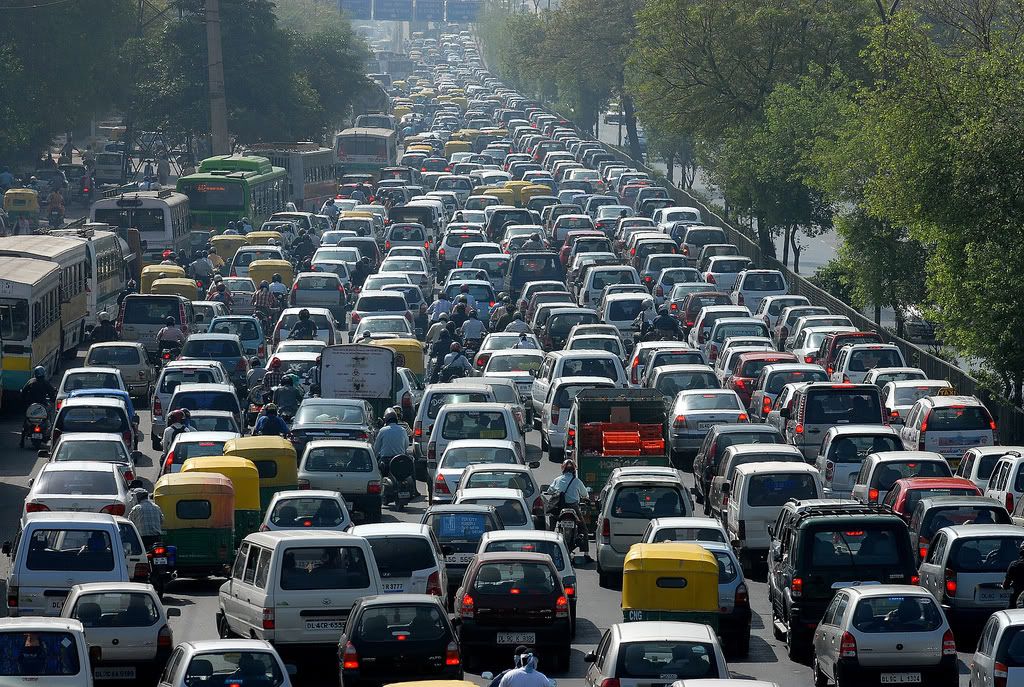 There are some people who labor under the misconception that gas taxes fund highway maintenance cost.
The notion is quite absurd on the face of it. The share of the federal highway fund that goes to roadworks is greater than the share of driving that takes place on funded highways, so obviously driving on unfunded streets … mostly urban and inner-suburban city streets … yields gas taxes that cross-subsidize driving on funded highways.
For example, here is the 2008 FHA Highway Statistics on highway revenues as a percentage of total disbursements:
- 46.61% Motor Fuel and Vehicle Taxes
- 5.11% Tolls
- 4.57% Property Taxes and Assessments
- 22.19% General Fund Appropriations
- 9.60% Investment Income and other Receipts
- 10.95% Bond Issue Proceeds
Of course, the gas tax and vehicle tax revenues are collected for all road uses, and only directed to qualifying highways. While qualification of urban streets for state gas tax funding varies by state, urban streets that do not qualify for national or state highway designation are excluded from federal highway gas taxes.
Of course, over half a century of subsidy has channeled traffic onto these federally funded highways (that is, Interstate, National, State, County and Township highways), but still, according to the introduction to the 2011 CBO report on alternative approaches to highway funding:
About 25 percent of the nation’s highways, which carry about 85 percent of all road traffic, are paid for in part by the federal government.
… so the direct gas tax and vehicle tax proceeds from driving on federally funded highways is at most 85% of 46.61%, or about 40%.
And, of course, this is also a substantial overstatement, since that is about 15% from Federal gas taxes and about 25% from state gas taxes. And in most states, gasoline is exempt from state and local sales taxes, so that only a portion of state gas taxes are an actual additional user fee, with much of the state gas tax simply being a diversion from the general fund. It would be as if alcohol sales in a state charged a “drinks tax” which went into providing infrastructure in support of drinking parties ~ and were exempted from state sales tax.
I don’t have any recent figures on how much of total state gas tax revenues is an increment over what would be the sales tax proceeds on sales tax exempt gasoline sales, and how much is a diversion, but if the additional user tax component is between 40% and 60% of total state gas taxes, then total “farebox cost recovery” of the highway system is between 30% and 35%.
While “nobody serious seriously believes that gas taxes fully fund our nation’s highways”, anybody who has read the Tea Party Parade that fills many online newspaper comments sections when a rail project is covered knows that lots of people are happy to make the absurd claim.
Now, that absurd claim is simply wishful thinking. It collapses immediately when presented with the publicly available Federal Highway Administration figures. The fact that it is confidently stated by so many serves to establish how many people are happy to state facts that are blatantly false, often passed on from someone else equally misinformed because it sounded like something that ought to be true.
…
B’ Spokes: It’s worth noting that the bulk of the “farebox cost recovery” of the highway system goes to interstate highways. And I will assert that in terms of simple dollars analogy all the money that cars pay in “user fees” go toward the interstate highway system… roads that cyclists are prohibited from using. So when it comes to roads that all modes use, we all help pay for. If cars get a specific “user” tax then why can’t we treat our sales tax as a user tax that helps fund the roads? Keep in mind that outdoor recreation spending is near twice that of motor vehicles (and a portion of motor vehicle spending is exempt from sales tax.)
the farebox recovery ratio above is not a ratio of physical cost imposed upon the highway system by driving, but a ratio of revenues to our inadequate highway spending. From the ASCE report cited above (p. 99), 5yr road spending of $380.5b can be set against total investment needs of $930b, for a 59% shortfall.
Outdoor Industry report says recreational cycling pumps $81 billion into U.S. economy each year
by Jonathan Maus, Bike Portland
…
According to the report, Americans spend more on bicycling gear and trips ($81 billion) than they do on airplane tickets ($51 billion). That $81 billion is spread between $10 billion on bikes, gear, and accessories and over $70 billion on bicycle "trip related sales." The direct economic impact of that spending supports 772,146 jobs. The report claims that the "ripple effect spending" of all this bicycling activity is over $198 billion and supports 1,478,475 jobs.
…
The OIA says outdoor recreation is an "overlooked economic giant." With annual spending at $646 billion, it’s third in total annual consumer spending behind only financial services/insurance and health care spending. By way of comparison, total annual spending on motor vehicles and parts is just $340 billion.
…
https://bikeportland.org/2012/06/20/outdoor-recreation-report-says-bicycling-pumps-81-billion-into-u-s-economy-each-year-73608
Quit Griping About Gas Prices — It’s All in Your Head!
Sean Williams makes a lot of excellent points here: https://www.dailyfinance.com/2012/06/26/quit-griping-about-gas-prices—-its-all-in-your-/
So I will assert that the issue really boils down to people just driving too much, come on folks lets bike or walk and quit using the car for every little thing.
US House of Representatives rejects funding Vehicle Mileage Tax studies
by Scott Wilson (Rational Transport) on Road Pricing
The blocking of further funding for this was proposed by Rep. Chip Cravaack (R-Minn.). He argued that it would “would hurt rural drivers, cost a lot to implement, since it would require devices in each car to track how many miles have been driven, and could impinge on privacy rights.”Now I’m not one to argue whether or not the Federal Government ought to be responsible for funding such studies, as it really depends on whether it wants to supplement or replace its own Federal gas tax. However, I can question the view of Rep. Cravaack, which contains a range of misconceptions.
I’ll go through them point by point:
“Hurts rural drivers”: This is a question of equity, and whilst the issue of equity raises claims of winners and losers, the only sure way to ensure equity is to charge according to a fair allocation of costs. Charging by distance on the face of it, means you use the road network more so you pay more. However, does that mean rural users are likely to be overcharged? There is a paucity of accessible research on the revenue generated by different roads by location. However, what I have seen over the years indicates that rural roads get heavily cross subsidised simply because the fixed costs of those roads can’t be recovered easily from the very low volumes of traffic on them. So the question comes as to who should subsidise them or if there is a better way to take this into account. One way is to ask whether the access value of a road to a property might better be recovered from charging the property itself as well as the motorist. That could mean not charging rural trips as much, because property owners value others being able to get to their properties. My counter-argument to this one, is that vehicles visiting rural areas should also pay. Besides, fuel taxes hurt people who can’t afford new fuel efficient vehicles. There is a concern that is worthy of debate, but rural roads will equally benefit if heavy trucks pay for the long mileage they undertake on them. My point is that what is charged (and how it is charged) should reflect cost.
For more good points continue reading here: https://roadpricing.blogspot.com/2012/06/us-house-of-representatives-rejects.html
B’ Spokes: Something I want to bring up as well as I have heard that rural drivers resent subsidizing mass transit since they don’t benefit from it. Well then why should city drivers subsidize rural roads?
rural roads get heavily cross subsidised simply because the fixed costs of those roads can’t be recovered easily from the very low volumes of traffic on them.
Anyway the current system isn’t working too well and it seems such a shame not to look at other ways to get the job done.
Has the U.S. Reached "Peak Car"?
B’ Spokes: This article in Scientific American has a lot of interesting points but I would like to comment a bit about their subtitle "Traffic is easing as more Americans are deciding to drive less, sell their cars or not buy one at all"
My comment is to contrast "a 1.2 percent decline in vehicle miles traveled (VMT) last year" with "traffic congestion in the United States fell by 27 percent last year". While exactly what is cause and effect is still under consideration I still want to point out for consideration that just a small reduction in VMT results in larger relief of congestion. This is due in part because once a roadway is at the saturation point of maximum traffic the addition of just a small amount traffic cause a cascading delay effect (think of one person hitting the brakes on a crowded highway and then all those behind are now also hitting the brakes), a catastrophic failure (think grid lock but something similar happens once people have to wait more then one cycle for a light causing more and more people to wait in the queue at each cycle) or just a "simple" traffic accident (happens on average every 5 minutes in Maryland and "accidents" are the MAJOR cause of traffic delays.)
The short of it is our road designs cannot gracefully handle additional traffic above a certain threshold, they fail and they fail severely. I will assert that’s why just a small reduction in VMT will result in a larger reductions of congestion.
My point in bringing this all up is because we cannot afford to build enough roads to have congestion free driving. But we can afford to provide alternate transportation to keep travel times for all at tolerable levels. And that’s the question we should be asking, are travel times at a tolerable level and forget about congested roads (they are inevitable.) And on this point I will assert average commute travel time of around a half hour is tolerable and the "worst" of 5 more minutes* is not that big of a deal. Of course we should try and improve this but the main thrust should be on alternate transportation (not more road projects at the expense of alternate transportation) as that will yield the most bang for the buck.
The Scientific American article: https://www.scientificamerican.com/article.cfm?id=has-us-reached-peak-car-americans-driving-less
Continue reading “Has the U.S. Reached "Peak Car"?”
Halfway
On the transportation bill, Republicans agreed to drop two issues that have nothing to do with transporation (the Keystone pipeline – an issue of their own creation – and the EPA coal ash regulations) and in return Democrats “gave up on $1.4 billion for conservation and agreed to allow states more leeway in how they use money that was once mandated for landscaping, bike improvements and pedestrian walkways” much of which is directly related to transportation. This from a bill that was already a compromise with Senate Republicans. So Democrats gave into Republican demands not once, but twice, and somehow Barbara Boxer can say with a straight face ““I am so glad that House Republicans met Democrats halfway.” I’m sorry to tell you, but that is not halfway. If she thinks it is, then I would love to sell her a used car.
Via The Wash Cycle
Postcard from Crested Butte: Bicycles as form and function
By David T. Whitaker, AICP, Smart Growth Maryland
…
Another interesting observation about Crested Butte is that most bicycle traffic does not occur on trails or even on sidewalks in the town. Adults and children alike ride their bicycles down the middle of streets in Crested Butte. Although some trails exist in and around the town, bicyclists of all ages in Crested Butte ride primarily on town streets. This public acceptance of bicycle travel is a continuation of a town tradition where bicycles are considered functional transportation.
This was not entirely by happenstance. This was the result of policy decisions made by town elected leaders, planners and park and recreation staff. Enhanced bicycle activity in the town supports Crested Butte’s reputation as one of the original locations in the development of the mountain bike. It says to visitors: “If you come to Crested Butte, bring your bike.” Therein lays a story unique to this Colorado community. Town officials in Crested Butte value human travel higher than they do motor vehicular travel.
…
https://smartgrowthmd.wordpress.com/2012/06/28/postcard-from-crested-butte-bicycles-as-form-and-function/
******************************************************************************************
B’ Spokes: I’ll note I miss our rides with the Mayor, I believe it is the political connections that can make biking mainstream.