
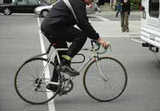
 Early in the 20th century, bicycling to do errands or to work was common in the United States, and seeing bikes on racks on the back of streetcars was not unusual. Commuters often used a combination of walking, cycling and taking mass transit. Even in the 1940s, bicycling was still a major means of transportation for not-too-distant trips.
But that began to change in the 1950s and 60s, when car use rapidly accelerated, fueled by the building of the high-speed Interstate highway system, heavily subsidized through federal funding. Ultimately crisscrossing over 40,000 miles, the new freeways chiseled through cities and towns, sometimes splitting neighborhoods in two, and created new pathways for development and sprawl far away from urban centers.
Bicycling and walking increasingly took a back seat to driving or riding in cars. By 1990, the Federal Highway Administration called bicycling and walking "the forgotten modes" of transportation.
Continue reading “Cycling to Work Enjoys a Rebirth”
The Health Benefits of Cycling
From CTC:
Who Should Read this Briefing?
This briefing is intended for anyone who is looking for one of the most convincing arguments to persuade people to cycle, to promote cycling or provide for cyclists. It should be equally useful for individuals and organisations concerned about physical inactivity and who need to know more about the health benefits of taking up cycling.
Some Things To Think about
|
| Cycling can help the environment |
|
PJ is biking to Brazil to pass the Climate Stewardship Act

 Yes, PJ (Paul Park) is embarking on a bicycle journey from the Mount Rainier (MD) Bike Coop all the way through Central America, across the north coast of South America to the city of Natal in northeastern Brazil. PJ is raising funds and collecting signatures to pass groundbreaking global warming legislation in Congress–the McCain-Lieberman Climate Stewardship and Innovation Act. see www.undoit.org
PJ will embark on the journey Sunday, Sept. 17th at 9:30am towards Fredericksburg via Mount Vernon. I invite you to join me on the beautiful ride to Mount Vernon! Meet at the Mount Rainier bike coop (behind city hall and library in alley) Sunday, Sept. 17th at 9:30am.
Follow PJ on his journey at www.biketobrazil.blogspot.com.
Cycling to help fight cancer?
BBC news is running a store (https://news.bbc.co.uk/2/hi/health/5300998.stm) about a man who used cycling to help fight cancer.
Considering a Hybrid?
The amount of tax credit available for hybrid cars varies by the make and model of the car. Tax credit information can be found at www.irs.gov. If you plan on buying a Toyota Prius, a popular hybrid car model, you should consider that if you want the full $3,150 tax credit available, you need to purchase it by the end of September. After this month, the tax credit will be reduced by half.
Continue reading “Considering a Hybrid?”
E85 Fueling Station Opens in Baltimore
 The first state-owned E85 ethanol fueling facility in Maryland opened in August. The facility is at the State Office Center in Baltimore. The goal is to have more of the state
Continue reading “E85 Fueling Station Opens in Baltimore”
Tell us about a bad development near you
 From environmentmaryland.org:
Development in Maryland is out of control, and it is paving over our open
spaces, polluting the Chesapeake Bay, and hurting our quality of life. That’s why
Environment Maryland is working to pass policies that will help Maryland grow in a
smarter, more sustainable way.
To prove that uncontrolled growth is a problem, we need to document cases of
sprawling development from all across the state. Do you live, work, or play near a
development that is going up and paving over a farm or forest? Is your local
creek polluted by runoff from a construction site or new development? Write and
tell us your story, and send us a picture if you have one.
Tell DNR not to sell water from state lands
 The Department of Natural Resources wants to sell water from state parks to private developers. These waters sustain the environment around them and should be kept in reserve for emergencies, not sold to the highest bidder.
Email Ronald Guns, the Deputy Secretary of the Department of Natural Resources, and tell him that state waters should only be used for emergencies and that any policy to allow the sale of state waters must allow public input in the process.
Continue reading “Tell DNR not to sell water from state lands”
Are Cyclists Destroying the Earth?
 In case you have not read or heard about the New York Times article about the paper by Karl Ulrich and the rebuttal by Andrew Leonard; Leonard summaries Ulrich position as "Cyclists live longer, thus consuming more energy, bad for environment. Result: Bikers lose all will to live." And Paul Higgins position as "Cyclists aren’t fat, thus lower healthcare costs, providing money for carbon abatement. Result: Bikers save the world."
Links to articles and papers follow:
Continue reading “Are Cyclists Destroying the Earth?”